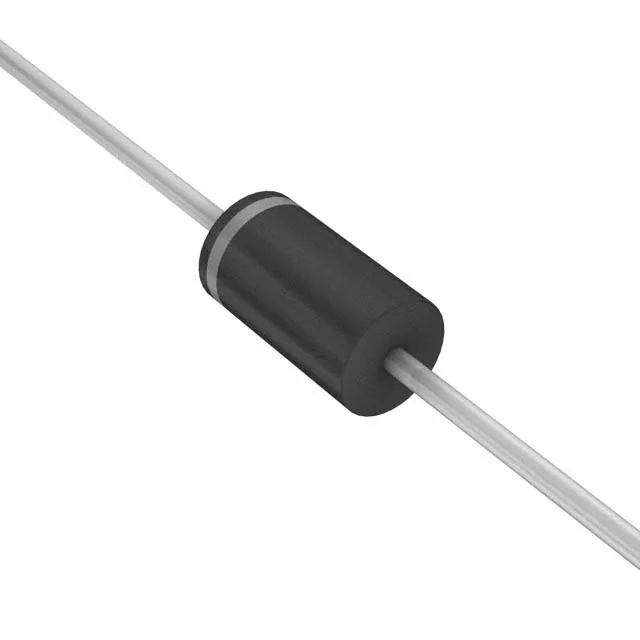
What the 1500W rating means for your board
The 1.5KE13C-E3/54: That 1500 W rating defines the energy it can absorb in a single surge — at the clamping voltage of 19 V, it handles a peak current of 78.9 A. If your circuit sees repetitive surges or longer-duration transients, the 1500 W rating is the absolute ceiling; derate for duty cycle. The reverse standoff voltage is 10.5 V, meaning it starts conducting above that level and clamps at 19 V max. The breakdown voltage range (11.7 V min) ensures it triggers before the protected rail sees damaging overvoltage. For a 12 V supply bus, this part sits right at the threshold — it holds off normal 12 V transients but catches spikes before they reach the downstream silicon.
Obsolete — sourcing reality for this TVS
Vishay lists the 1.5KE13C-/54 as Obsolete. If you are supporting an existing board, this is the exact part; for a new design, look at the current 1.5KE series from Vishay or a pin-compatible alternative in the same DO-201AA footprint. The through-hole DO-201AA (DO-27) axial package is field-serviceable with a soldering iron — no hot-air station needed. The bidirectional marking is usually a band on the cathode end; orientation matters only if you install it backwards (it will still clamp, but the breakdown symmetry means it works either way in a bidirectional circuit).
The 175°C max junction means it can sit next to a hot power supply or in a sealed enclosure without derating the surge capability, as long as the ambient stays below 150°C or so (the junction-to-ambient thermal path in a through-hole part is better than a surface-mount equivalent).