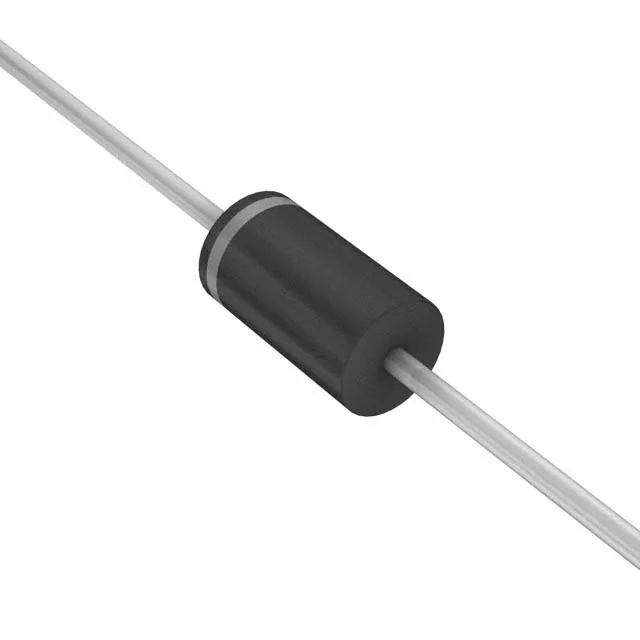
Obsolete AEC-Q101 TVS — what it means for your BOM
The 1.5KE12CHE3/54: It carries AEC-Q101 automotive qualification, meaning it passed the reliability stress and temperature screening required for under-hood and chassis-domain electronics — a grade that matters when the replacement must match the original qualification level.
1500 W peak pulse — clamping and current handling
The clamping voltage at that peak current is 17.3 V max, which means a 12 V nominal rail sees the transient clipped to 17.3 V before the downstream components see damage. Peak pulse current is 86.7 A under the same 10/1000 µs condition — the device absorbs that current while holding the clamp voltage. The reverse standoff voltage (working voltage) is 9.72 V typical, so it stays out of conduction below that level and only activates when the transient exceeds the breakdown threshold of 10.8 V min.
Bidirectional single-channel in DO-201AA axial
A single bidirectional channel — one device protects both polarities on the same line, simplifying the BOM count for AC-coupled or bipolar signal rails. The DO-201AA (DO-27) axial-lead package mounts through-hole, which is a legacy footprint still common in high-reliability and high-vibration assemblies where a soldered lead is preferred over a surface-mount joint.