1.8 V fixed rail with 73 dB PSRR — what the spec means
The Toshiba TCR2EF18,LM(CT is a single-output positive linear regulator delivering a fixed 1.8 V at up to 200 mA. Its 73 dB PSRR at 1 kHz makes it a candidate for powering analog front-ends, sensor bias, or low-noise RF supply rails where the upstream switching regulator needs rejection. The 0.31 V maximum dropout at 150 mA means the input rail must stay above 2.11 V to hold regulation — a 3.3 V bus or a 2.5 V intermediate rail provides comfortable headroom. Quiescent current sits at 60 µA, which is moderate for a 200 mA LDO; it is not the lowest-Iq part for always-on coin-cell applications, but it is acceptable for continuously powered industrial or telecom circuits where the load is present most of the time.
Dropout and headroom — sizing the input rail
The 0.31 V dropout at 150 mA is the worst-case figure across temperature and load. At lighter loads the actual dropout is lower, but for BOM budgeting use the max number: a 1.8 V rail needs at least 2.11 V input under all conditions. A 3.3 V rail with 5% tolerance (3.135 V min) gives over 1 V of headroom, so the regulator operates well away from dropout. If the input comes from a 2.5 V rail or a battery that sags to 2.2 V, the margin gets thin — check the dropout against your minimum input voltage at the full load current.
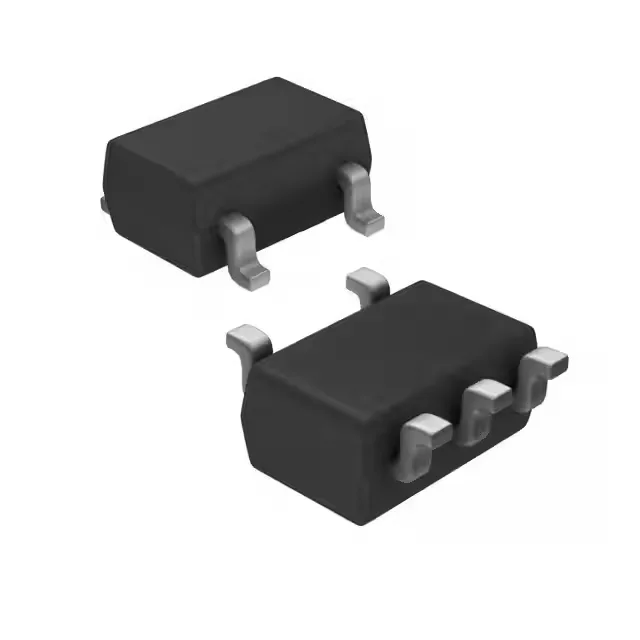
Package and footprint — SC-74A / SOT-753
The part comes in a surface-mount package designated SOT-753. This is a five-pin small-outline transistor package. The Enable control pin allows the regulator to be shut down for power sequencing or low-power standby modes. The SMV supplier device package is the Toshiba code for this SOT-753 variant.
Temperature grade — industrial range
It is not specified for the full automotive under-hood range, so for engine-bay or exhaust-adjacent placements look at the TCR3DF series or a higher-temperature-grade LDO.