Active lifecycle — no end-of-life pressure on this BOM line
The RN1402,LF: This simplifies inventory planning for a line that uses this pre-biased transistor in signal-level switching — you are not chasing a sunset part. ROHS3 compliance is confirmed, which keeps the part acceptable across current regulatory markets without exemption tracking.
Pre-biased NPN — integrated resistors shrink the BOM
The resistor divider sets the bias point externally, so you eliminate two discrete resistors from the board — a clean BOM consolidation for high-volume or space-constrained designs. The 50 V collector-emitter breakdown and 100 mA maximum collector current cover general-purpose switching of logic-level loads, relay coils, or small signal lamps. The 200 mW power dissipation limits continuous conduction to light duty — this is a signal transistor, not a pass element.
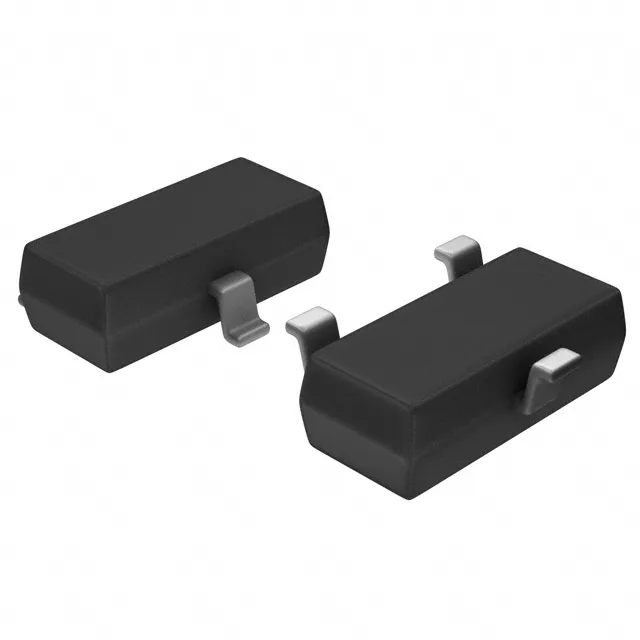
S-Mini (SOT-23-3) — a standard footprint for automated assembly
The S-Mini package (also known as TO-236-3, SC-59, or SOT-23-3) is a widely used three-lead surface-mount footprint. The 250 MHz transition frequency means it switches fast enough for typical digital interface or low-speed switching applications without introducing propagation delay issues. The reel format is the standard for volume production; the cut tape suits prototype or low-volume builds.
Saturation and gain — what the numbers mean for the switching decision
Vce saturation is specified at 300 mV maximum with a 250 µA base current driving 5 mA collector current. This guarantees the transistor will saturate with a base drive of about 200 µA when switching 10 mA — a ratio that simplifies drive circuit design from a microcontroller GPIO.