Driving inductive loads in automotive boards
The ULQ2003ATDQ1 is a 7-channel low-side NPN driver array from Texas Instruments, part of the Automotive AEC-Q100 series. It is designed to switch relay coils, solenoids, and small inductive loads directly from a microcontroller's logic outputs, with each channel sinking up to 500 mA at a maximum load voltage of 50 V. The inverting input logic and 1:1 input-to-output ratio mean a logic-high on the input turns the output on — no extra inversion stage needed in the firmware or external logic.
Current per channel and thermal budget
Each of the seven outputs is rated for 500 mA continuous. In a typical relay-driving application where each relay coil draws 100-200 mA, the total package dissipation stays within the SOIC's thermal limits even when all channels are active simultaneously. The 50 V maximum load voltage gives headroom for 12 V and 24 V automotive relay coils, including the inductive flyback spike that the integrated clamp diodes handle. No external Vcc supply is required for the driver logic — the input pins are directly compatible with 5 V logic families, including standard CMOS and TTL outputs. The parallel interface simplifies PCB routing: each input connects straight to a GPIO pin without level-shifting components.
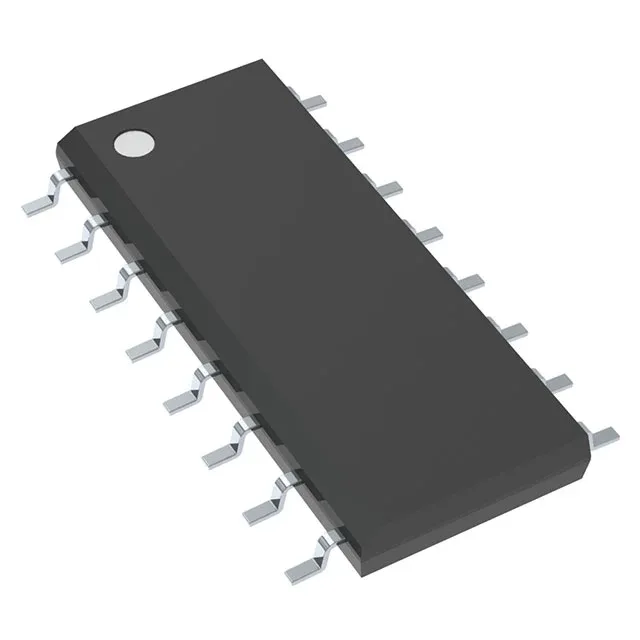
The part is supplied in tube packaging, 16-SOIC (0.154-inch width, 3.90 mm body). The supplier device package is 16-SOIC, surface-mount, with a standard footprint that matches the industry-wide SOIC-16 land pattern.