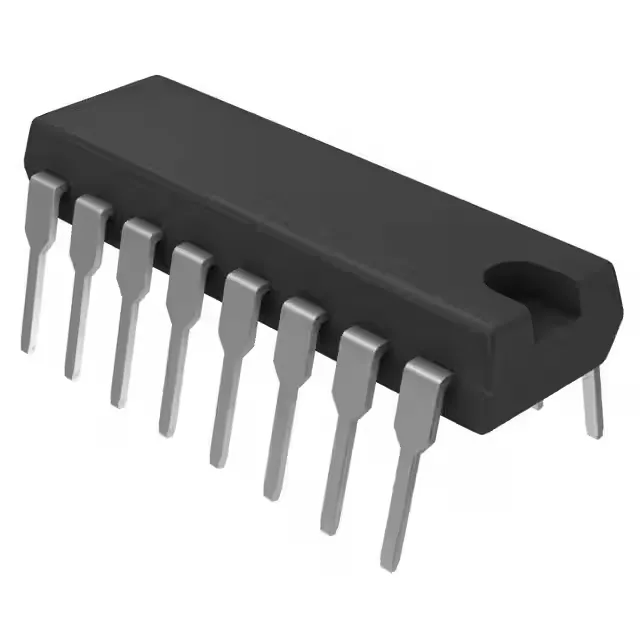
The ULN2004AIN: ROHS3 compliant — no lead, no restricted substances per the latest EU directive. No special handling or exemption paperwork needed for shipping into regulated markets.
Seven Darlington outputs — what 500 mA per channel actually drives
Each of the seven outputs sinks up to 500 mA continuously with a 50 V maximum load voltage. That covers the vast majority of 24 V industrial relays, 12 V automotive relays, small solenoids, and indicator lamps you will encounter in a control panel or ECU. The input-to-output ratio is 1:1 — each of the seven inputs switches its corresponding output directly. No decoding, no multiplexing. The input is inverting: a logic high on the input turns the output on (sinks current to ground). This matches the typical microcontroller GPIO behaviour where an active-high signal drives the load. No external Vcc supply is required for the logic side — the base drive comes from the input signal itself. This simplifies the PCB layout: just route the GPIO lines and the load supply, no separate bias rail.
Through-hole DIP-16 — field-swappable without a hot-air station
On a customer site, you can pull the old part from a DIP socket and push in a fresh ULN2004AIN with no soldering, no hot air, no rework station. That is the difference between a 30-second swap and a board pull. The supplier device package is 16-PDIP — the standard through-hole plastic DIP. Pin 1 is clearly marked with a notch and a dot on the package body; orientation is unambiguous even under a flashlight in a dim equipment room.
Industrial temperature range — -40 to 105 °C
That is the full industrial temperature band — cold storage warehouses, unventilated enclosures next to a motor drive, engine-bay-adjacent electronics in off-highway vehicles. The Darlington outputs have enough thermal margin to run at 500 mA per channel at 85 °C ambient with reasonable derating.