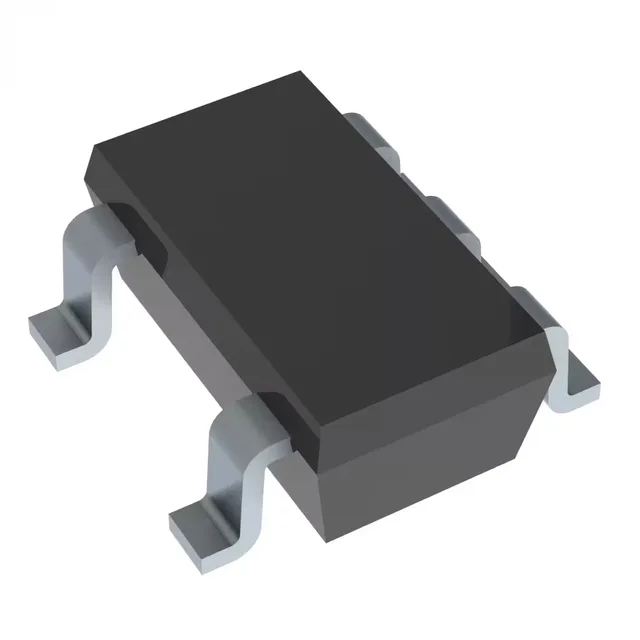
Texas Instruments UCC27537DBVR — Power Management (PMIC / Gate Driver)

UCC27537DBVR Low-Side Gate Driver, 2.5A/5A, SOT-23-5

MPNUCC27537DBVR
Active

Texas Instruments UCC27537DBVR, single low-side gate driver, 2.5A source / 5A sink peak output, 15ns rise / 7ns fall typ, 10V~32V supply, non-inverting input, SOT-23-5 package, -40°C~140°C junction.

$1.3900Ref. price · indicative, final on quote
Independent supplier — new & surplus stockAuthenticity-screened · ESD-safe packingListing updated Jul 2026

Specifications

UCC27537DBVR specifications
ParameterValue
Gate typeIGBT, N-Channel MOSFET
Input typeNon-Inverting
Channel typeSingle
MountingSurface Mount
Supply voltage10V ~ 32V
Logic voltage - VIL, VIH1.2V, 2.2V
Current - peak output (Source, sink)2.5A, 5A
Operating temperature-40°C~140°C(TJ)
PackageTape & Reel (TR); Cut Tape (CT)
CaseSC-74A, SOT-753
Number of drivers1
Driven configurationLow-Side
Rise (Fall time)15ns, 7ns

Product details

Single low-side driver with 2.5A/5A peak — what the bench sees

The UCC27537DBVR is a single-channel, non-inverting low-side gate driver from Texas Instruments, designed to drive IGBT and N-Channel MOSFET gates.

Supply rail and temperature — the design envelope

The driver operates from a 10 V to 32 V supply, covering the common 12 V and 24 V industrial bias rails without needing an extra regulator. The non-inverting input simplifies the control interface — no inversion logic needed between the PWM controller and the gate.

Package and footprint — SOT-23-5 reality

Housed in a SOT-23-5 package (SC-74A, SOT-753), this driver takes up minimal board area. Surface-mount assembly is straightforward with standard reflow profiles.

Frequently asked questions

Is UCC27537DBVR suitable for driving IGBTs?

Yes. The gate type is specified for both IGBT and N-Channel MOSFET gates, with a 2.5 A source / 5 A sink peak output that can charge and discharge the gate capacitance quickly.

What is the rise time of UCC27537DBVR?

Typical rise time is 15 ns and fall time is 7 ns, enabling fast switching transitions that reduce crossover losses in hard-switched topologies.