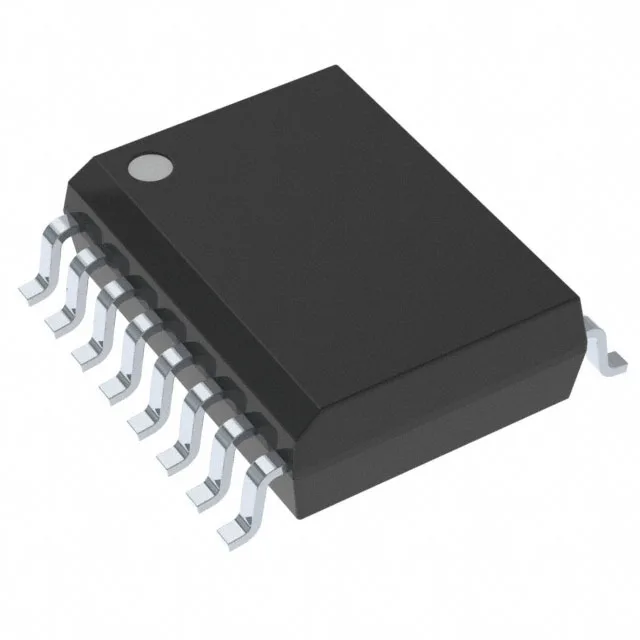
Switching frequency and topology reach
The UC3846DW switches at up to 500 kHz, which sets the practical upper bound for transformer size reduction in isolated designs. At that frequency, the core cross-section shrinks, but the switching losses in the external FETs and the transformer leakage inductance become the limiting factor — not the controller itself. The device supports Boost, Flyback, Forward Converter, Half-Bridge, and Push-Pull topologies, so a single controller BOM line can serve multiple isolated and non-isolated architectures across different board designs. The 50% maximum duty cycle is inherent to the current-mode architecture — it prevents subharmonic oscillation at duty cycles above 50% without external slope compensation. For designs that need >50% duty (e.g., a wide-input Flyback at low line), the designer must move to a push-pull or half-bridge topology where the two outputs interleave to effectively double the on-time per switching period.
Supply range and control features — what the ratings actually mean for the rail
The 6.95 V to 40 V supply range covers the common industrial and telecom rails: a 12 V bus (nominal 13.8 V in a vehicle, 12.0 V in a panel) sits comfortably in the middle, and a 36 V telecom rail stays under the 40 V absolute maximum with a few volts of headroom. The undervoltage lockout threshold is 6.95 V minimum — if the input rail droops below that during a brownout, the controller shuts down cleanly rather than running the external FETs into linear mode. Integrated control features include Current Limit, Enable, Frequency Control, and Soft Start. The current-limit comparator senses the primary-side current through an external sense resistor — the cycle-by-cycle limit protects the power stage during startup or overload without relying on a slow fuse. The Soft Start pin ramps the reference voltage, so the output rises monotonically without overshoot. Frequency Control allows the oscillator to be synchronized to an external clock via the Clock Sync pin, which is useful when multiple converters must share a switching frequency to avoid beat-frequency noise on the input bus.
Temperature grade and package — board-fit considerations
The package is a 16-SOIC wide-body (0.295″ body width, 7.50 mm). That is the wider SOIC-16 footprint, not the narrow 3.9 mm version — the pad layout is different, and a narrow-SOIC footprint will not fit the wide body.