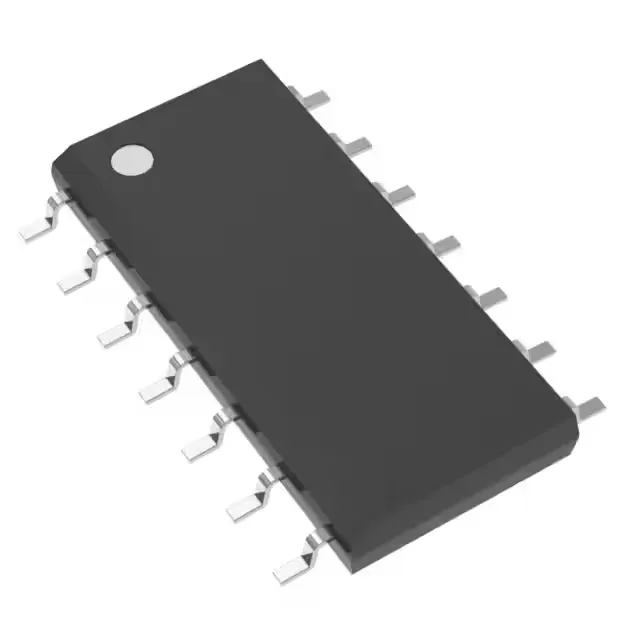
Texas Instruments UC3845ADG4 — Power Management (PMIC / Gate Driver)

UC3845ADG4 PWM Controller, 48% Duty Cycle, Up to 500 kHz

MPNUC3845ADG4
End of Life

Texas Instruments UC3845ADG4 current-mode PWM controller, 48% max duty cycle, up to 500 kHz switching, 7.6 V to 30 V supply, 14-SOIC package, tube.

Independent supplier — new & surplus stockAuthenticity-screened · ESD-safe packingListing updated Jul 2026

Specifications

UC3845ADG4 specifications
ParameterValue
Output typeTransistor Driver
MountingSurface Mount
Voltage - supply (Vcc (Vdd))7.6V ~ 30V
Frequency - switchingUp to 500kHz
I/O channels1
Output phases1
Duty cycle48%
Operating temperature0°C~70°C(TA)
PackageTube
FunctionStep-Up, Step-Down, Step-Up/Step-Down
TopologyBoost, Buck, Flyback, Forward
Clock syncNo
Case14-SOIC (0.154\", 3.90mm Width)
Control featuresFrequency Control
Output configurationPositive, Isolation Capable
Synchronous rectifierNo

Product details

Current-mode PWM controller for isolated and non-isolated supplies

The Texas Instruments UC3845ADG4 is a current-mode PWM controller designed for step-up, step-down, and step-up/step-down topologies including boost, buck, flyback, and forward converters. It delivers a single transistor-driver output with a maximum duty cycle of 48%, a ceiling that sets the transformer reset time in flyback and forward designs. Switching frequency reaches up to 500 kHz, allowing the use of smaller magnetic components for compact power supplies.

The supply range of 7.6 V to 30 V (Vcc/Vdd) covers common 12 V and 24 V industrial buses directly, eliminating the need for an extra pre-regulator.

Frequently asked questions

What is the maximum duty cycle of UC3845ADG4?

The maximum duty cycle is 48%, which limits the on-time relative to the switching period. This is a key constraint for transformer-reset in flyback and forward converter designs.

Can UC3845ADG4 be used in a boost converter?

Yes, the UC3845ADG4 supports boost topology as one of its listed functions (step-up). The 48% duty cycle cap applies, so the output-to-input voltage ratio in continuous conduction mode is limited to approximately 1/(1-D) = 1.92×.