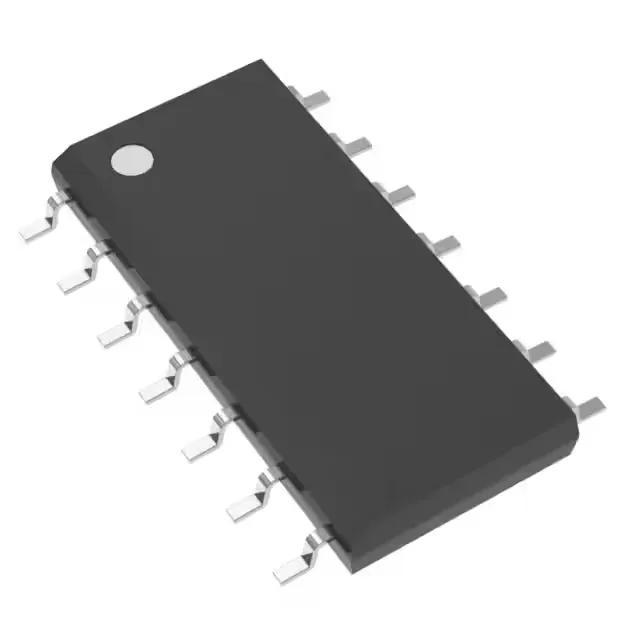
UC3843DTR

Texas Instruments

Texas Instruments UC3843DTR, current-mode PWM controller, up to 500kHz switching frequency, 97% max duty cycle, 12V-28V supply, transistor driver output, 14-SOIC package, 0°C~70°C.

Texas Instruments UC3843DTR
Download datasheet (PDF)
[IN STOCK] In Stock: 228 pcs
$1.25/ pc

Volume pricing

Buy Now

MOQ 1 · Tape & Reel (TR); Cut Tape (CT) · RoHS · EIA-481 · DAP/DDP · T/T

Technical specifications

UC3843DTR specifications
Parameter / AttributeSpecification / Value
Output typeTransistor Driver
MountingSurface Mount
Voltage - supply (Vcc (Vdd))12V ~ 28V
Frequency - switchingUp to 500kHz
I/O channels1
Output phases1
Duty cycle97%
Operating temperature0°C~70°C(TA)
PackageTape & Reel (TR); Cut Tape (CT)
FunctionStep-Up, Step-Down, Step-Up/Step-Down
TopologyBoost, Buck, Buck-Boost, Flyback, Forward
Clock syncNo
Case14-SOIC (0.154\", 3.90mm Width)
Control featuresFrequency Control
Output configurationPositive, Isolation Capable
Synchronous rectifierNo
100% Footprint Match · Solder-Ready (No PCB Redesign Needed)

Need Stock or a Drop-in Second-Source for UC3843DTR?

Package: DIP-8 / SOIC-8 · Pin-compatible replacements with immediate Shenzhen spot stock

Footprint Match 98%
Supply Chain & Allocation Reality:

The UC384x family is the current-mode PWM controller inside a generation of offline switching supplies, adapters, chargers and ATX standby rails - an 8-pin part that appears in repair in every country, and the most-fitting-wrong-part in power-supply benches. The four suffixes are not interchangeable decorations: the start-up threshold is either 16V (3842/3844, offline rails) or 8.4V (3843/3845, low-voltage rails), and the maximum duty cycle is either full (3842/3843) or 50 percent (3844/3845, for half-bridge and push-pull topologies). The wrong suffix shows up as a supply that will not start, or a transformer that saturates.

Verified Pin-Compatible Replacements (4 verified alternatives)

UC3843 TI / onsemi / STMicroelectronics DIP-8 / SOIC-8
Pin-to-Pin (Minor Clock/Init Tuning)
Availability & Target Pricing:

The Low-Voltage Start Sibling

Shenzhen Spot Stock (24-48h Dispatch)

Electrical & Core Specs:

Identical current-mode PWM engine with the UVLO window shifted down: 8.4V turn-on / 7.6V turn-off against 16V / 10V for the UC3842. Full duty cycle, 500kHz class oscillator, 5V reference, totem-pole output.

Works from lower VCC rails - the part for DC-DC converters running from 12V and 24V buses.

Compatibility & Drop-In Notes: In an offline supply fitted as a substitute for a 3842, the supply can attempt to start at a lower rail voltage - usually it simply works off the aux winding, but brown-out behavior and start-up resistor design were sized around 16V. Do not swap in this direction as routine repair policy; match the original suffix.
Package & Solder Footprint: DIP-8 / SOIC-8, pin-identical across the family.
Shenzhen Warehouse Stock & MOQ: Deep multi-fab stock; the DC-DC builders part.
UC3844 TI / onsemi / STMicroelectronics DIP-8 / SOIC-8
Pin-to-Pin (Minor Clock/Init Tuning)
Availability & Target Pricing:

The 50% Duty Offline Sibling

Shenzhen Spot Stock (24-48h Dispatch)

Electrical & Core Specs:

Same 16V UVLO as the 3842 with the output limited to 50 percent maximum duty by an internal toggle flip-flop - the part for half-bridge and push-pull offline converters.

16V turn-on / 10V turn-off; the offline start-up window.

Compatibility & Drop-In Notes: Fitting a 3844 where a 3842 belongs halves the maximum duty and the converter underperforms or drops out; fitting a 3842 where a 3844 belongs lets a push-pull transformer see full duty - saturation and blown switches. The suffix is functional, not cosmetic.
Package & Solder Footprint: Same 8-pin body and pin assignment.
Shenzhen Warehouse Stock & MOQ: Stocked as the half-bridge part; keep the four suffixes separated in the drawer.
UC3845 TI / onsemi / STMicroelectronics DIP-8 / SOIC-8
Pin-to-Pin (Minor Clock/Init Tuning)
Availability & Target Pricing:

Low Start and 50% Duty Combined

Shenzhen Spot Stock (24-48h Dispatch)

Electrical & Core Specs:

The fourth quadrant of the matrix: 8.4V UVLO with the 50 percent duty flip-flop - low-voltage push-pull and half-bridge converters.

8.4V turn-on / 7.6V turn-off.

Compatibility & Drop-In Notes: Listed to complete the ladder; substitutions across the family must carry both numbers - threshold AND duty - or the repair reintroduces the failure.
Package & Solder Footprint: Same DIP-8 / SOIC-8 pinout.
Shenzhen Warehouse Stock & MOQ: Stocked as part of the four-suffix kit for supply repair benches.
UC2842 TI / onsemi DIP-8 / SOIC-8
100% Drop-in (Zero Code Change)
Availability & Target Pricing:

The Industrial-Temperature Grade

Shenzhen Spot Stock (24-48h Dispatch)

Electrical & Core Specs:

Electrically the same controller in the UC284x (industrial temperature) grade against the UC384x (commercial) - same thresholds and duty per suffix digit.

Same UVLO scheme; the 2 in the prefix is temperature range, not function.

Compatibility & Drop-In Notes: When a supply runs hot or outdoors, the industrial grade is the honest replacement. Reading the prefix as function misleads - only the last digit sets threshold and duty.
Package & Solder Footprint: Same body and pinout across all temperature grades.
Shenzhen Warehouse Stock & MOQ: Stocked for industrial service work; verify the prefix on the marking.
Buyer & Quality Checklist for Sourcing Alternatives
  • Read two numbers before any substitution: UVLO start threshold (3842/3844 = 16V, 3843/3845 = 8.4V) and maximum duty (3842/3843 = full, 3844/3845 = 50 percent). Wrong threshold = will not start or starts on brown-out; wrong duty = underperformance or transformer saturation.
  • On the 50-percent parts (3844/3845) the oscillator runs at twice the switching frequency by design - when repairing, set RT/CT for the doubled value or everything downstream shifts.
  • The start-up network is part of the chip choice: offline designs charge VCC through a resistor from the high rail, and the aux winding must take over before the 10V turn-off. Fitting a lower-threshold suffix changes when that handover happens.
  • Current-sense input tolerances and leading-edge blanking are fixed in silicon - if a repair needed a snubber change to behave, suspect the wrong suffix or a clone die before redesigning the sense network.
  • The clone market here is deep: relabeled no-name dies pass DC tests and drift on frequency. For fleet repairs, keep verified lots and photograph the markings.
  • UC184x / UC284x / UC384x are temperature grades of the same function - use the industrial grade for hot enclosures rather than substituting down.
Frequently Asked Technical Questions

Q: What is the difference between UC3842 and UC3843?

A: The start-up threshold: UC3842 turns on at 16V (offline supplies), UC3843 at 8.4V (low-voltage DC-DC). Everything else - including full duty capability - is the same. Match the original suffix so the start-up network behaves as designed.

Q: Can I use a UC3842 where a UC3844 was fitted?

A: No - the 3844 is the 50-percent-duty part used in push-pull and half-bridge designs. A full-duty part in that socket can saturate the transformer and destroy the switching devices. The last digit encodes the duty limit; respect it.

Q: Why does my supply not start after a PWM chip replacement?

A: Check the suffix first: a 3843/3845 fitted into an offline design starts at 8.4V and the bias winding handover may misbehave, and a 16V part in a low-voltage design never reaches its threshold. Wrong-threshold swaps are the most common self-inflicted repair failure on this family.

Technical details

What the 97% duty cycle buys you in a boost or flyback

The UC3843DTR is a current-mode PWM controller from Texas Instruments that handles step-up, step-down, and step-up/step-down topologies including boost, buck, buck-boost, flyback, and forward converters. The 97% maximum duty cycle means this controller can regulate a boost output with a very small input-to-output differential — useful when the input rail sags close to the target output and you need the converter to stay in regulation rather than drop out.

Switching frequency ceiling — 500 kHz

Switching frequency goes up to 500 kHz, which lets you shrink the magnetic components and output capacitors. At the upper end of that range, the transformer core volume in a flyback drops roughly in inverse proportion to frequency. The trade-off is higher switching losses in the external MOSFET and more attention to layout — the 14-SOIC package has 0.154-inch body width, so the gate-drive loop inductance needs to be tight to avoid ringing at 500 kHz.

Supply range and isolation capability

The Vcc range of 12V to 28V covers most auxiliary-winding voltages from a flyback transformer or a rectified 24V industrial rail. The transistor driver output is isolation-capable — it can drive a pulse transformer or an optocoupler gate drive, which is the standard way to get isolated feedback in a flyback or forward converter. No synchronous rectifier drive on-chip, so the secondary side needs its own controller if you want to replace the output diode with a FET.

Not rated for the engine bay, a rooftop telecom cabinet, or any unheated outdoor location.

UC3843DTR
[ALLOC] verified
Quote