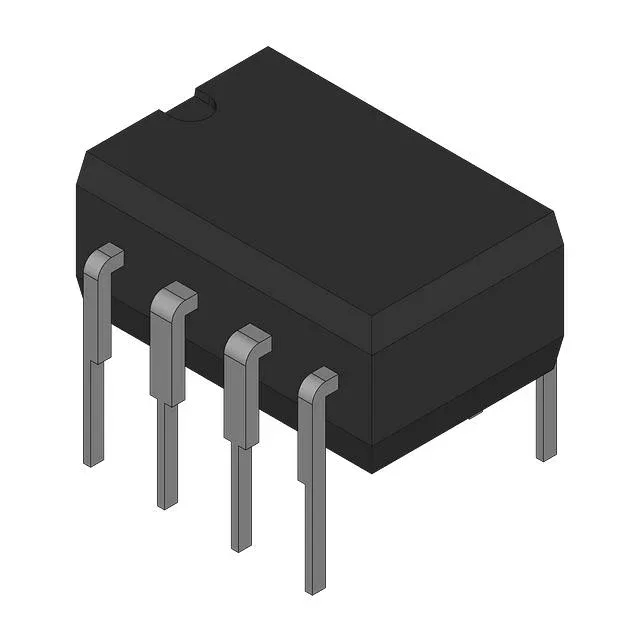
It is a single-circuit op-amp with a 0.5 V/µs slew rate, 1.7 mA supply current, and an input offset voltage of 1 mV.
For a 10 V peak-to-peak output swing, the full-power bandwidth works out to roughly 8 kHz. That makes this part suitable for audio-frequency conditioning, slow servo loops, and DC-level shifting — not for high-speed ADC drivers or video lines. If your application needs faster settling, the TLV9351IDCKR (20 V/µs) is a modern surface-mount alternative, but it is not pin-compatible.
Through-hole 8-DIP — legacy board fit and rework
The 8-DIP (0.300", 7.62mm) through-hole package is the reason this part still sees active procurement. It drops directly into legacy sockets, protoboards, and boards where rework ease matters. The mounting type is through hole, so plan for hand-solder or wave-solder assembly — no reflow profile needed. The supplier device package is 8-PDIP.
The supply span from 10 V to 30 V gives flexibility across common rail voltages — ±5 V to ±15 V split supplies, or a single 12 V or 24 V rail.
However, this is a very old design — the 741 architecture dates to the late 1960s — and TI may shift production to newer nodes. For new designs, consider a modern pin-compatible alternative if the supply chain risk is a concern.