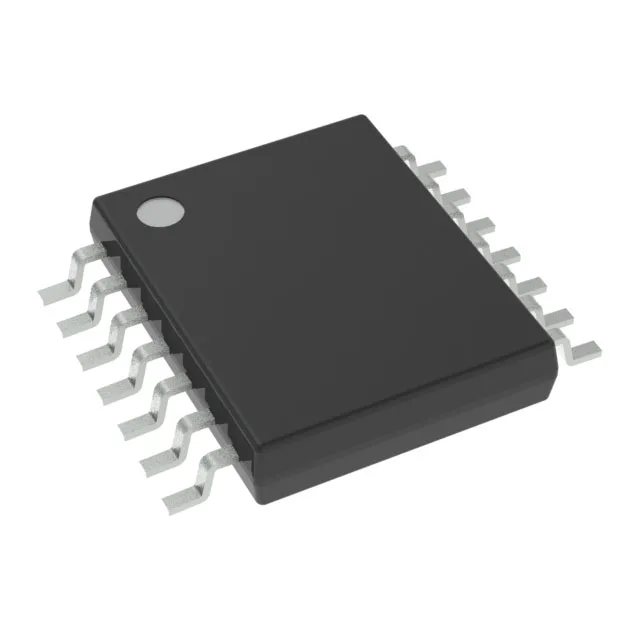
The Texas Instruments TXU0104QWBQARQ1 is a unidirectional voltage-level translator with four channels, designed for automotive applications that require AEC-Q100 qualification. It translates logic signals between two independent supply rails, VCCA and VCCB, each operating from 1.08 V to 5.5 V. The part supports data rates up to 200 Mbps, making it suitable for SPI, UART, GPIO, and other moderate-speed interfaces in automotive ECUs, ADAS modules, and body-control units. The 14-WQFN package with wettable flank enables automated solder-joint inspection, a requirement for high-reliability automotive production lines.
Both VCCA and VCCB accept the same 1.08 V to 5.5 V range, covering standard logic levels without separate voltage regulators.
200 Mbps — speed tier check
The 200 Mbps data rate covers most on-board serial buses. It will not handle DDR memory interfaces or high-speed serial links like LVDS.
Wettable flank — why it matters for production
The 14-WQFN package has a wettable flank, meaning the side of the package terminal is plated to accept solder. This allows automated optical inspection (AOI) to verify solder-joint quality after reflow — a standard requirement in automotive electronics manufacturing. Without it, you would need X-ray inspection to confirm hidden solder joints under the QFN.
It is ROHS3 compliant. For dual-sourcing flexibility, the TXU0304BQAR is a functional alternative — same 200 Mbps data rate, unidirectional, 4 channels, and similar supply range — though it lacks the wettable flank and may not carry AEC-Q100 qualification.