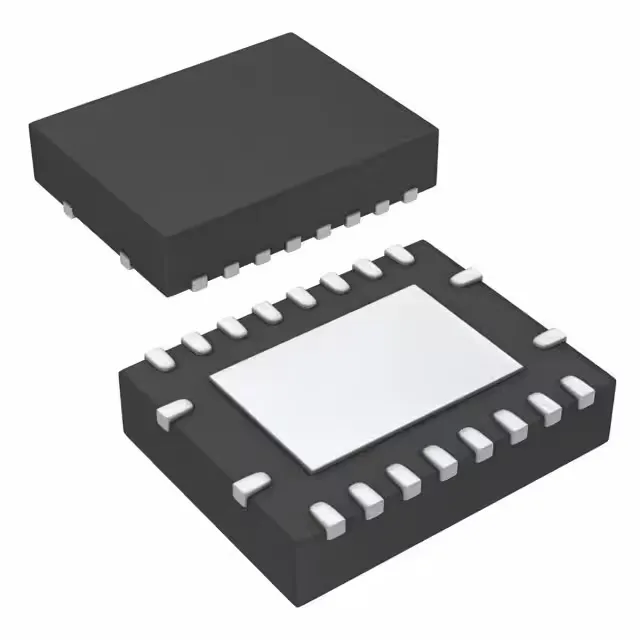
The Texas Instruments TXS0108ERGYR is an 8-channel bidirectional voltage-level translator that shifts logic signals between two independent supply domains without a direction-control pin. Its auto-direction sensing means the direction of each channel is determined by the bus state — the translator drives the side that is being pulled low or high by the external driver. This saves a GPIO on the host controller and simplifies firmware, but it also means the part relies on external pull-up resistors on the open-drain outputs to define the high-level voltage. The data rate reaches 60 Mbps, which comfortably handles SPI, SDIO, UART, and most parallel interfaces at moderate clock speeds — though for I2C at 400 kHz or 1 MHz the margin is generous, and the auto-direction architecture actually suits the bidirectional SDA/SCL lines well.
The 1.4 V minimum on VCCA means it can work with sub-1.8 V low-power processors, though the 60 Mbps data rate may be limited at the low end of the supply range — the edge rate slows as the operating voltage drops. For a typical 3.3 V to 1.8 V translation at 60 Mbps, the part runs clean with minimal jitter as long as the PCB layout keeps the VCCA and VCCB decoupling capacitors within a few millimetres of the respective pins.
Package and footprint — 20-VQFN with exposed pad
The TXS0108ERGYR comes in a 20-VFQFN exposed-pad package, supplier device package 20-VQFN measuring 3.5 x 4.5 mm. For a part that draws only microamps of quiescent current, thermal dissipation isn't the concern; rather, the exposed pad provides a low-inductance ground return for the high-speed switching edges. MSL 3 is typical for this package class; if the moisture-barrier bag has been open longer than the floor-life window, a 24-hour bake at 125°C is needed before reflow.
The 85°C upper limit rules out under-hood or engine-bay placements, but it's fine for most indoor and outdoor equipment with moderate thermal rise. The auto-direction sensing works across the full temperature range without calibration — the threshold voltages track the supply rails, so translation accuracy holds from cold start to hot soak.
For a BOM line, this means no near-term obsolescence risk, and the part can be qualified for production without a last-time-buy contingency.