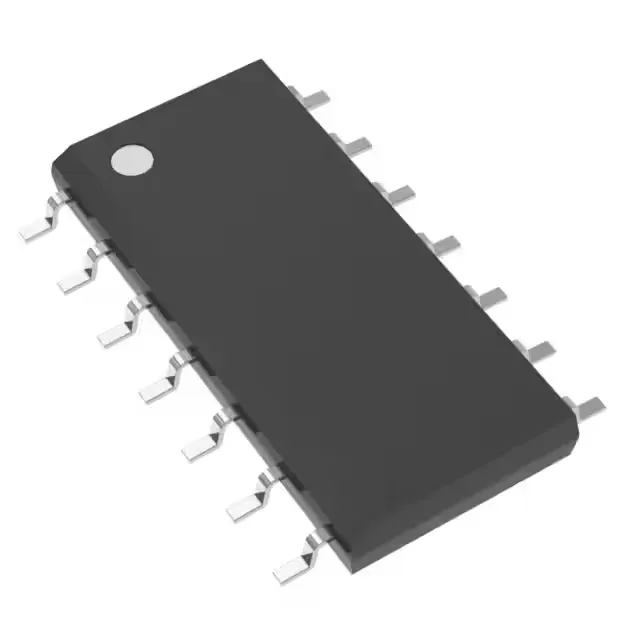
What this level translator does on the board
The Texas Instruments TXS0104EDG4 is a 4-channel bidirectional voltage-level translator that handles open-drain and push-pull signals without a direction-control pin — the auto-direction sensing decides the data flow on each channel independently. The 24 Mbps data rate covers most SPI and UART buses but falls short of full-speed I2C's 400 kHz or standard SPI's tens of MHz — it is a fit for slower serial interfaces and GPIO expansion, not high-throughput links.
Supply rails and signal compatibility
Because VCCA and VCCB are independent, this part can translate between any two voltage levels within their respective ranges — for example, a 1.8 V microcontroller talking to a 3.3 V sensor, or a 3.3 V FPGA I/O driving a 5 V legacy peripheral. The output type supports both open-drain (I2C-style) and push-pull (SPI/UART-style) signals, so it works with wired-AND buses as well as standard CMOS outputs. The auto-direction sensing means no software toggling of a direction GPIO — the translator detects the drive direction from the bus itself, which simplifies firmware and reduces pin count on the host controller.