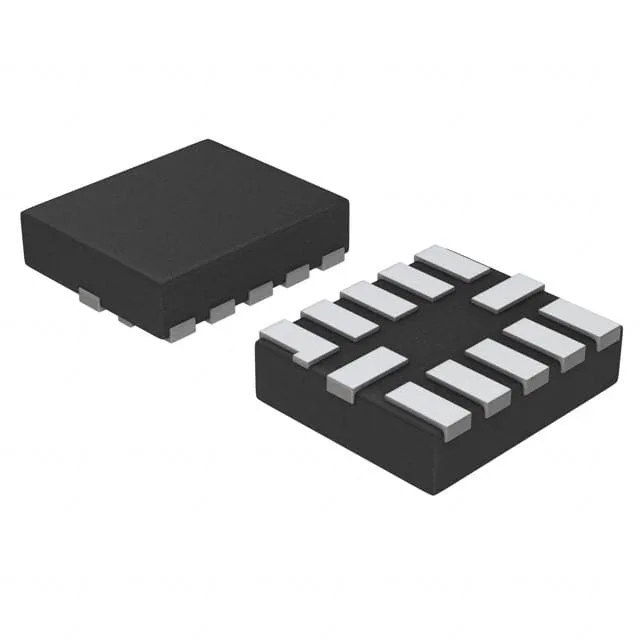
The Texas Instruments TXB0104RUTR is a 4-channel bidirectional voltage-level translator that moves logic signals between two independent supply domains without a direction-control pin — the auto-direction sensing circuitry handles bus turn-around on the fly. It is the part you reach for when a 1.8 V sensor needs to talk to a 3.3 V MCU, or a 5 V legacy peripheral interfaces with a 1.2 V core. The 100 Mbps data rate covers SPI, UART, GPIO, and most parallel-bus handshake lines below 50 MHz clock rates.
At 100 Mbps the TXB0104RUTR can sustain a 50 MHz clock or a 100 Mbit/s data stream with a 10 ns bit period. That is fast enough for quad-SPI at 50 MHz, for a 50 MHz SDIO bus, and for any UART or I2C (which runs orders of magnitude slower). It is not fast enough for a 100 MHz DDR memory interface or a 200 MHz serialiser — for those you step up to a 200 Mbps or 420 Mbps translator like the TXU0304BQAR or SN74LXC2T45DTTR. The practical takeaway: if your bus runs above 50 MHz, this part is not the right fit; below that, the 100 Mbps rating gives you comfortable margin.
Auto-direction sensing — no DIR pin, no firmware overhead
The auto-direction sensing means the part detects the data flow on each channel by comparing the input edge to the output load. No GPIO pin wasted on a DIR signal, no firmware state machine to toggle direction before a bus transaction. This simplifies both the PCB layout (one fewer trace) and the BOM (no pull-up or pull-down on a DIR line). The trade-off: because the sensing circuit relies on edge detection, the part is not recommended for open-drain signals like I2C — the weak pull-up cannot guarantee a clean edge for the direction sense. For I2C, use a dedicated open-drain translator such as the TXS0104 series.
Package and rework — 12-UQFN (1.7 x 2 mm)
The TXB0104RUTR comes in a 12-UFQFN package with a 1.7 x 2 mm body and a 0.4 mm pitch — small enough for space-constrained designs but still hand-reworkable with a hot-air station and fine-tipped tweezers. The supplier device package notes the 1.7 x 2 mm footprint; the exposed pad is minimal, so thermal mass is low and the part lifts cleanly at 300 °C air.