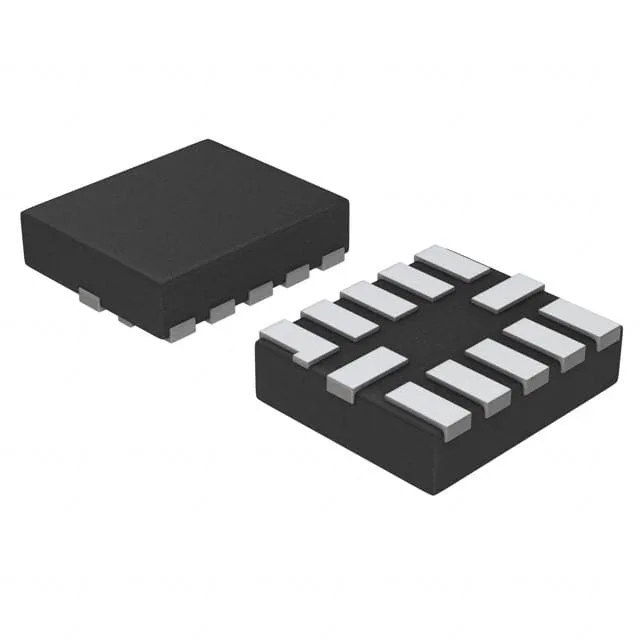
Automotive-grade level translator with auto-direction sensing
It handles four bidirectional channels with auto-direction sensing, meaning no direction-control pin is needed — the part detects the data flow and switches accordingly. Data rate is rated at 100Mbps, fast enough for SPI, UART, and most parallel buses in an automotive ECU.
What the 100 Mbps data rate means for your bus
At 100Mbps, this translator handles typical SPI clock rates up to 50 MHz (double-edge) and UART baud rates well above 1 Mbps. For a 1.8 V sensor communicating with a 3.3 V microcontroller, the 100 Mbps ceiling leaves enough margin for the signal to settle before the next edge. If your bus runs above 100 Mbps — say a QSPI at 80 MHz — the TXB0104 still works, but you need to keep the trace length under 2 inches and place the translator close to the driver to avoid reflections eating into the setup time.
Package and footprint: 12-UQFN (1.7 mm x 2 mm)
The TXB0104QRUTRQ1 comes in a 12-UFQFN package (supplier device package 12-UQFN, 1.7 mm x 2 mm). That is a small footprint — roughly the size of a 0805 resistor — so it fits tight layouts in automotive camera modules or sensor nodes. The pitch is 0.4 mm, which means a standard 0.3 mm stencil aperture for the solder paste; no special assembly tooling required. The exposed pad is not present on this package, so thermal dissipation is through the leads only — keep the ambient below 125°C.
No official successor has been announced — this is the part to design in for new automotive programs.