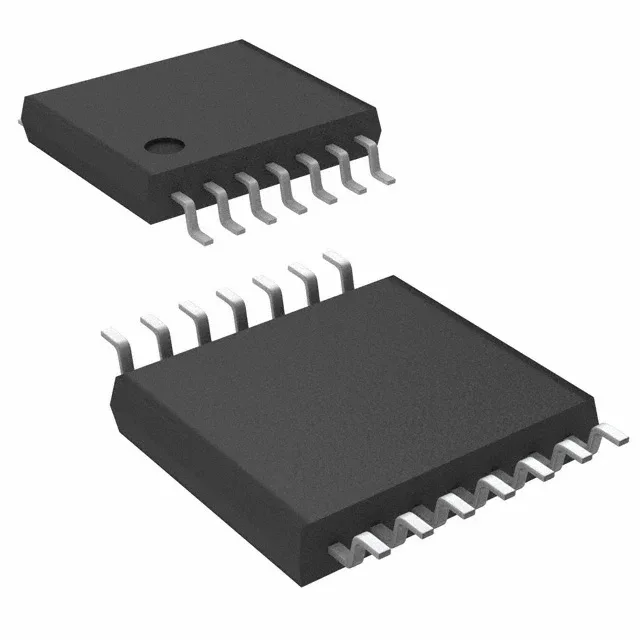
Four-channel bidirectional level shifter with auto-direction sensing
The Texas Instruments TXB0104QPWRQ1 is a four-channel bidirectional voltage-level translator designed for mixed-voltage digital systems. It belongs to the Automotive, AEC-Q100 series, meaning it has been qualified for automotive-grade reliability and is suitable for use in vehicle electronics, industrial controls, and other harsh environments where temperature and vibration tolerance are required. The translator operates at a data rate of 100 Mbps, sufficient for SPI, UART, GPIO, and most general-purpose digital interfaces. The output type is tri-state, non-inverted, and the device is housed in a 14-TSSOP package (4.40 mm width) for surface-mount assembly.
Auto-direction sensing — no DIR pin needed
The TXB0104QPWRQ1 uses auto-direction sensing to determine the data flow on each channel independently. This means the designer does not need to allocate a GPIO or a control signal to set the direction, which saves board space and reduces firmware complexity. The bidirectional channels are suitable for open-drain buses like I2C, as well as push-pull interfaces such as SPI, UART, and general-purpose GPIO. However, because the auto-sense circuit relies on edge detection, the part is not recommended for applications requiring continuous DC-level translation or for buses with very slow edges (e.g., some I2C implementations at low speeds may need an external pull-up and careful layout).
Active lifecycle and AEC-Q100 qualification
The part is AEC-Q100 qualified, which is the automotive stress-test qualification standard for integrated circuits. This qualification covers a range of reliability tests including high-temperature operating life, temperature cycling, moisture sensitivity, and electrostatic discharge. For buyers sourcing for automotive or high-reliability industrial programs, the AEC-Q100 designation provides documented assurance that the part meets the required quality and reliability benchmarks. The part is also ROHS3 compliant.
The device is supplied in a 14-TSSOP package with a body width of 4.40 mm and a 0.65 mm pin pitch. For PCB layout, the 14-TSSOP footprint is a standard JEDEC package, and the land pattern is widely available in most CAD libraries. The part is MSL 3 (Moisture Sensitivity Level 3) per typical TI TSSOP packages — if the moisture-barrier bag has been open for more than 168 hours, a bake before reflow is required to prevent popcorning.