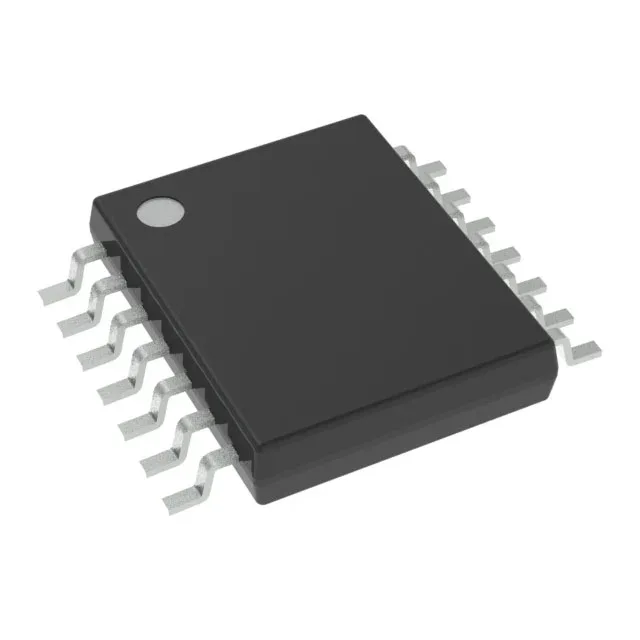
Auto-direction sensing — one less GPIO to route
The TXB0104PWR is a 4-channel bidirectional voltage-level translator from Texas Instruments. Its auto-direction sensing feature eliminates the need for a direction-control pin — the part determines data flow from the bus state, which simplifies both PCB layout and firmware.
Supply voltage range — what it buys you
VCCB spans 1.65 V to 5.5 V, so the same part bridges a 1.2 V FPGA bank to a 5 V legacy sensor or a 3.3 V MCU to a 5 V display interface. The 100 Mbps data rate is achievable across the full supply range, but edge-rate degradation at the lowest VCCA voltages should be verified against the load capacitance. Outputs are tri-state and non-inverted, which suits shared buses where high-impedance states prevent contention.
The ROHS3 compliance avoids the restricted-substance paperwork in EU-bound builds. For a production BOM, this part carries no imminent obsolescence risk — a straightforward fit for the bill of materials.
Temperature grade — industrial floor ready
That includes outdoor telecom cabinets, factory-floor sensor interfaces, and engine-bay-adjacent electronics that see moderate heat but not the full 125°C automotive soak.
Package — 14-TSSOP footprint
The 14-TSSOP package has a 4.40 mm body width and 0.65 mm pin pitch — a common footprint shared with many TI level translators. The supplier device package is 14-TSSOP, surface-mount.