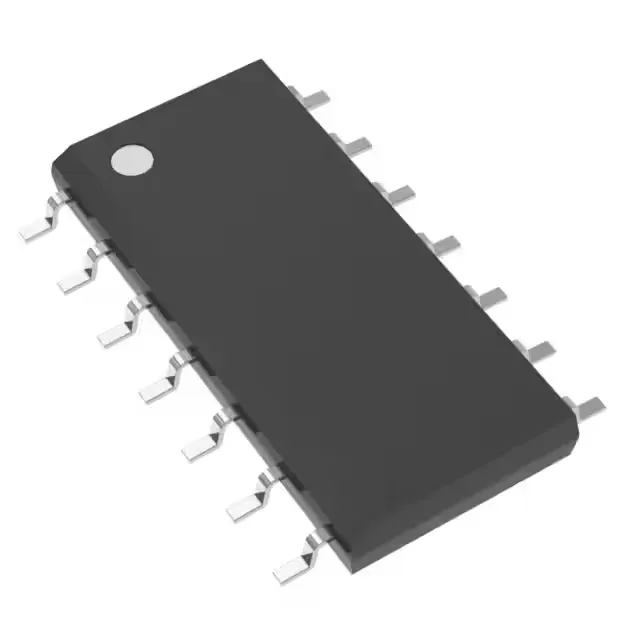
Four-channel bidirectional level shifter with auto-direction sensing
The auto-direction sensing feature makes it a drop-in solution for open-drain buses like I²C (fast-mode) and push-pull interfaces such as SPI and UART, as long as the data rate stays within the 100 Mbps limit.
The 100 Mbps data rate handles most board-level serial interfaces. For higher-speed buses like QSPI or SDIO at 200 Mbps, you would step up to the TXU0304BQAR, which pushes 200 Mbps but is unidirectional.
Supply rails and signal integrity — the gotcha on auto-direction
The auto-direction sensing works by detecting rising edges on one side and driving them to the other — this means the driving side must have enough drive strength to overcome the translator's internal pull-up resistors. If the source is a weak open-drain output, the edge may not slew fast enough to trigger the direction sense, and you get a corrupted level. An external pull-up on the slow side usually fixes it.
It is not qualified to AEC-Q100, so for under-hood automotive or 125°C environments you would look at the CAXC4T774QBQBRQ1, which is AEC-Q100 qualified and rated to 125°C.
For dual-sourcing resilience, the TXU0304BQAR is a functional alternative if you can accept unidirectional channels and a 200 Mbps ceiling — but it is not pin-for-pin compatible (different package).