100 Mbps bidirectional level shifting — no direction pin needed
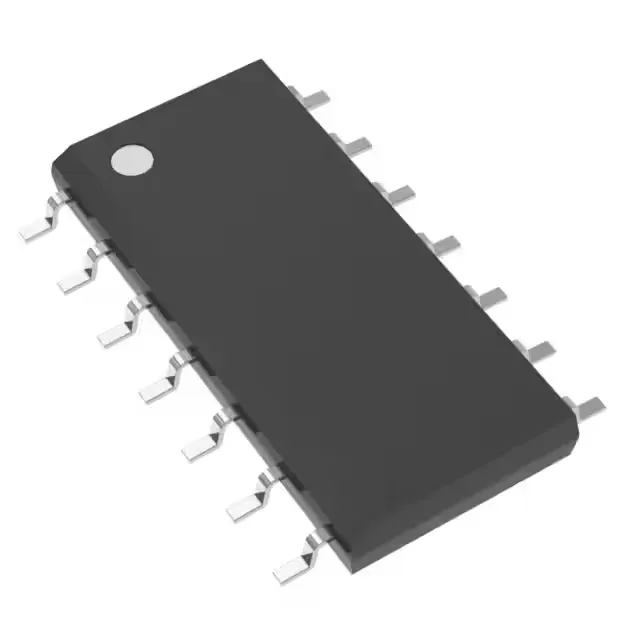
The Texas Instruments TXB0104D is a 4-channel bidirectional voltage-level translator in a 14-SOIC package. Auto-direction sensing means the part detects the data flow on each channel and switches direction without a dedicated control signal — useful for open-drain buses like I2C or MDIO where the direction changes mid-packet.
100 Mbps — what it buys on the bus
Rated at 100 Mbps, the TXB0104D handles SPI at 50 MHz, UART at several Mbps, and most parallel memory interfaces slower than 100 MHz. The tri-state, non-inverted outputs let you share a bus with other drivers without contention. If your design runs a faster serial link — say, 200 Mbps or above — the TXU0304BQAR (200 Mbps, unidirectional) or SN74LXC2T45DTTR (420 Mbps) are worth a look, though they trade auto-direction for speed or channel count.
Surface-mount 14-SOIC (3.90 mm body width) — a common footprint that reflows on a standard profile. The two supply rails are independent; sequencing is not critical because the part has an output-enable feature that holds outputs in high-impedance until both supplies are stable.
For dual-sourcing or a unidirectional alternative, the TXU0304BQAR offers 200 Mbps in a similar package but with fixed direction per channel — qualify the alternate early if your BOM needs a second source.