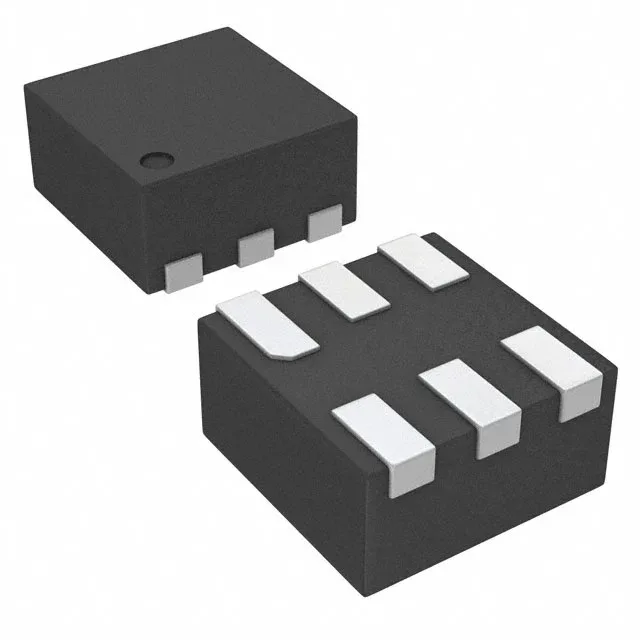
Active production — 2.6 µA Iq defines the battery-life decision
The TPS7A1028PDSER: The headline number for this part isn't the 300 mA output — it's the 2.6 µA quiescent current. That's the current the regulator burns just to stay alive, and at that level it's below the self-discharge rate of a typical lithium coin cell. A sensor node that spends 99% of its time in sleep mode with the LDO enabled will see the battery life limited by the load, not the regulator overhead.
90 mV dropout at 300 mA — the headroom rule
The maximum dropout voltage is 0.09 V at 300 mA output. The 3.3 V max input voltage confirms this is a low-voltage rail part, not a wide-VIN LDO.
PSRR profile — where the noise rejection lives
PSRR is 60 dB at 1 kHz, dropping to 35 dB at 1.5 MHz. That 60 dB (a factor of 1000) at audio frequencies means 10 mV of input ripple becomes 10 µV at the output — clean enough for an analog front-end. But above a few hundred kHz the rejection rolls off; a switching regulator running at 2 MHz will push ripple through unless the LDO's output capacitor handles the high-frequency bypass. The 35 dB at 1.5 MHz is about 56x attenuation, still useful but not the same margin as at 1 kHz.
Protection and control — Enable pin, OCP, OTP, UVLO
The Enable pin lets the system shut down the LDO entirely, dropping the supply current to near zero — useful for sequencing or power gating a peripheral. Protection features include over-current, over-temperature, and undervoltage lockout (UVLO), so a shorted load or a brownout on the input rail won't damage the regulator or the downstream circuitry. The 9 µA maximum supply current is the total current drawn from the input when the output is unloaded — essentially the quiescent plus any internal bias. The 2.6 µA quiescent is the typical operating current at no load; the difference covers the internal reference and control logic.