Active production — no BOM risk on this LDO
The TPS7A0333PYCHR: This single-output positive LDO delivers a fixed 3.3 V at up to 200 mA, with a maximum dropout of 310 mV at full load — the headroom between the input rail and 3.3 V must stay above that figure to maintain regulation.
300 nA quiescent current — battery-life enabler
Drawing just 300 nA typical quiescent current, this LDO's own consumption sits below the self-discharge rate of most lithium coin cells — an always-on sensor node that spends months in deep sleep between wake events runs years on the same battery. The Enable pin lets an external MCU or timer cut the LDO's output entirely, dropping the system load to near-zero when the downstream circuit is not needed.
55 dB PSRR at 1 kHz — noise rejection from switching rails
The 55 dB power-supply rejection ratio at 1 kHz means ripple from a upstream buck converter is attenuated by a factor of ~560 — a 10 mVpp switching artifact on the input becomes roughly 18 µVpp at the output, clean enough for an analog sensor front-end or RF transceiver supply. Input voltage range extends to 6 V max, so the LDO can run directly from a single-cell Li-ion (3.0-4.2 V) or a regulated 5 V bus without an intermediate stage.
4-DSBGA — footprint and assembly considerations
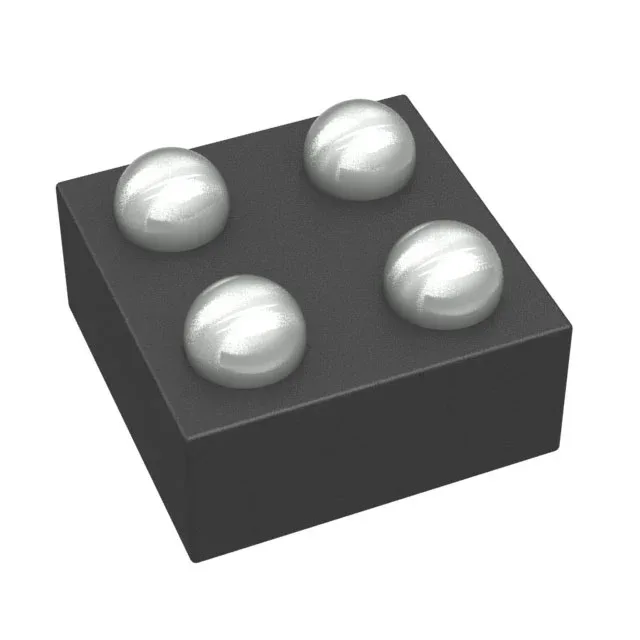
Housed in a 4-ball DSBGA measuring 0.64 x 0.64 mm, this package occupies roughly the area of a 0402 resistor — critical for ultra-compact wearable, hearable, or IoT module designs where board real estate is the tightest constraint. Surface-mount assembly requires a stencil designed for the 0.4 mm ball pitch; the exposed die attach pad on the DSBGA provides the primary thermal path, so the PCB copper landing pattern should match the recommended layout in the datasheet to keep junction temperature within the -40°C to +125°C operating range.
Protection suite for fault-tolerant operation
Built-in over-current, over-temperature, and under-voltage lockout (UVLO) protection means the LDO survives output shorts, thermal overload, and brownout conditions without external supervisory circuitry — the UVLO threshold prevents the output from turning on until the input rail is high enough to maintain regulation.