800 nA quiescent current — battery-life anchor spec
The TPS780300250DRVR draws 800 nA typical quiescent current (Iq) with no load. In a battery-powered sensor that sleeps 99% of the time, that Iq sits below the battery's self-discharge rate — the regulator's own draw doesn't shorten shelf life. Output capability is 150 mA continuous from a single LDO, with a fixed dual-output scheme: 3 V and 2.5 V rails from one device. The dropout voltage maxes at 0.25 V at 250 mA load, meaning the input rail needs only 0.25 V headroom above the output to stay in regulation.
PSRR profile — what 40 dB to 15 dB means for noise-sensitive rails
Power-supply rejection ratio (PSRR) is 40 dB at 10 Hz, rolling off to 15 dB at 1 kHz. At 40 dB, the regulator attenuates 100 mV of input ripple to 1 mV on the output; at 15 dB, the same ripple passes through at about 18 mV. For an analog front-end sampling below 100 Hz, the low-frequency rejection is adequate — but a switching converter upstream running at 500 kHz or above will need a post-filter before this LDO, because the PSRR above 1 kHz is not specified.
Package and board-fit — 6-WSON with exposed pad
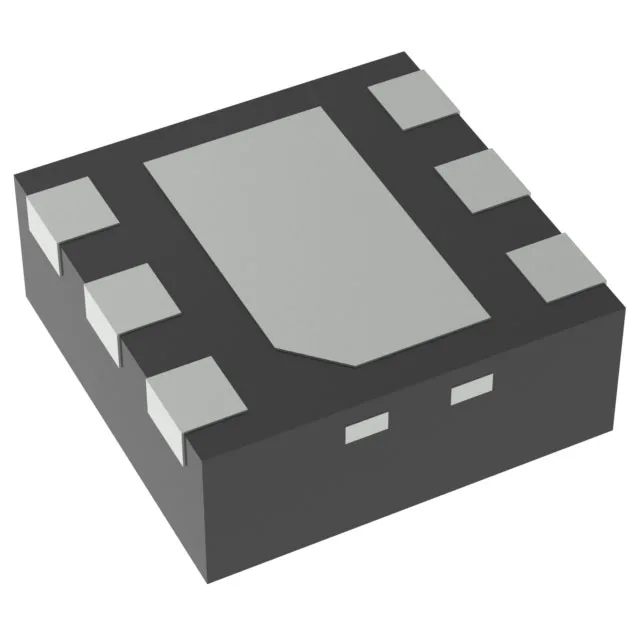
Housed in a 6-WDFN Exposed Pad package (2x2 mm body, supplier device package 6-WSON). MSL rating is not explicitly listed in the spec table, but the WDFN package with exposed pad typically ships at MSL-1 or MSL-2 — verify the reel label before the reflow profile is set. The part is ROHS3 compliant, so the solder paste should be a lead-free SAC alloy.
Protection features — over-current, over-temp, reverse polarity
Built-in over-current and over-temperature shutdown protect the regulator and load from fault conditions. Reverse-polarity protection on the input prevents damage if the supply is connected backwards — a common failure in field-wired battery packs. Enable pin (active high) allows the system to shut the LDO down to near-zero current when the load is idle.
The 125°C ceiling also means the part can be placed near a hot processor without derating the output current.