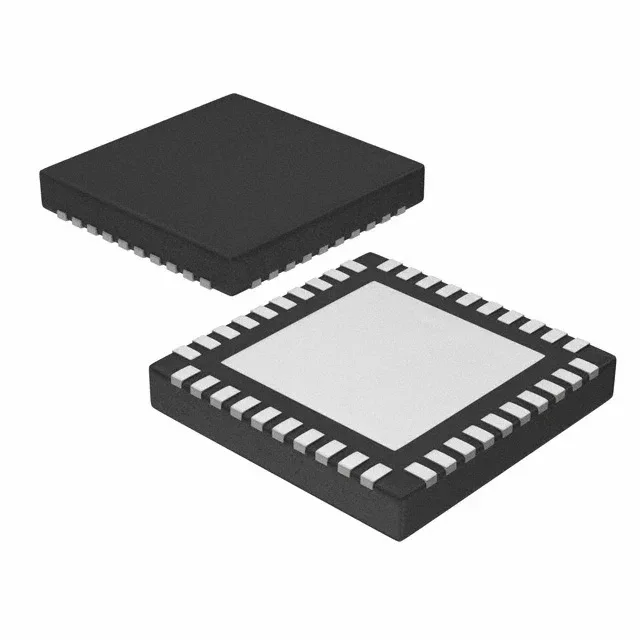
Three-rail power tree in a 6×6 mm QFN
Each output is adjustable from 0.8 V up to the input voltage, and the 300 kHz to 2.2 MHz switching frequency range lets you optimise the inductor footprint against conversion efficiency.
The 3 A channel is the primary rail — typically the core or I/O supply for a processor or FPGA — while the two 2 A channels cover auxiliary loads like transceiver or peripheral power. All three channels are synchronous rectified, which keeps the efficiency curve competitive across light- and full-load conditions without external Schottky diodes. The switching frequency is set with a single resistor; running at 2.2 MHz shrinks the inductor to a 2×2.5 mm footprint, while 300 kHz favours higher efficiency at the cost of larger magnetics.
The 40-VQFN (6×6 mm) with exposed pad requires a solder stencil aperture that covers at least 50 % of the pad area for reliable thermal and electrical contact; the datasheet layout recommendation should be followed closely.