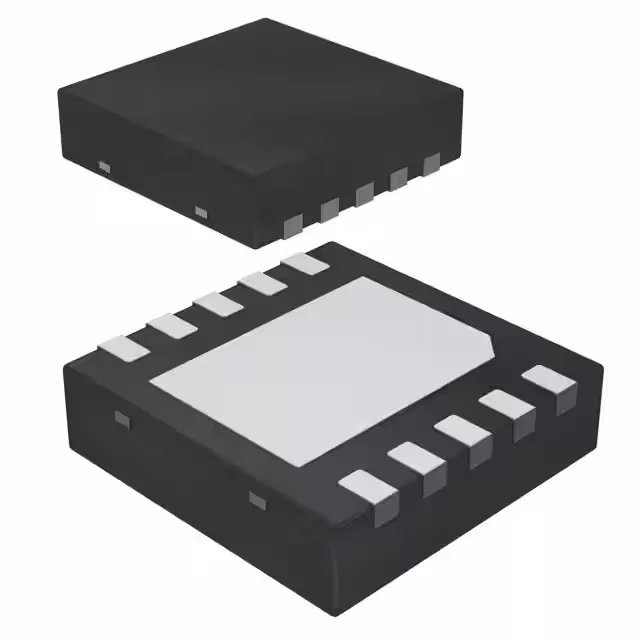
The TPS63060DSCR is a synchronous buck-boost converter from Texas Instruments that regulates a single adjustable output from an input spanning 2.5V to 12V. Its 2A switch rating means the part can deliver a continuous 1.8A at 3.3V from a single Li-ion cell, with the switch current limiting the load, not the inductor. The 2.4MHz switching frequency keeps the external inductor in the 1 µH to 4.7 µH range and the output capacitor under 22 µF — small enough for a compact 10-WSON (3x3) layout, but the fast edges demand a solid ground plane under the exposed pad.
Buck-boost topology — why it matters for battery-powered designs
A standard buck converter drops voltage; a boost raises it. The TPS63060DSCR does both seamlessly — when the input is above the target output it bucks, when the input drops below it boosts, and in the narrow overlap region it transitions through a buck-boost mode. For a 3.3V rail powered by a Li-ion cell (4.2V down to 3.0V), the converter bucks at full charge and boosts when the cell nears depletion, maintaining regulation across the entire discharge curve.
It does not reach the -55°C or 125°C extremes needed for avionics or under-hood automotive — if your BOM calls for that, look at the TPS63061-Q1 or TPS63062-Q1 variants with AEC-Q100 qualification. For the majority of portable and fixed industrial gear, this range is the standard fit.