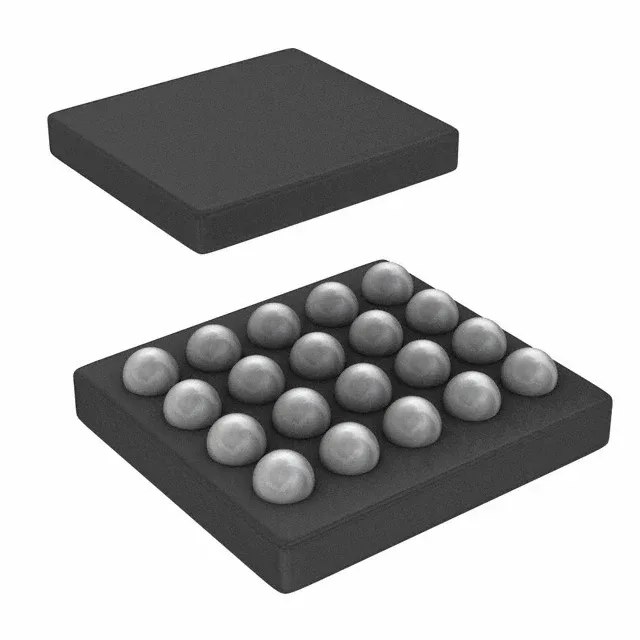
Texas Instruments TPS630252YFFT — Power Management (PMIC / Gate Driver)

TPS630252YFFT Buck-Boost Regulator, 3.5A Switch, 2.5MHz

MPNTPS630252YFFT
Active

Texas Instruments TPS630252YFFT, Buck-Boost Regulator, Fixed 3.3V Output, 3.5A Switch, 2.5MHz Switching, Surface Mount 20-UFBGA DSBGA, -40°C to 85°C.

$4.0700Ref. price · indicative, final on quote
Packaging20-UFBGA, DSBGA
RoHSROHS3 Compliant
Independent supplier — new & surplus stockAuthenticity-screened · ESD-safe packingListing updated Aug 2026

Specifications

TPS630252YFFT specifications
ParameterValue
Output typeFixed
MountingSurface Mount
Voltage - input5.5V
Voltage - output (Min (Fixed))3.3V
Output current3.5A (Switch)
Frequency2.5MHz
I/O channels1
Operating temperature-40°C ~ 85°C (TA)
PackageTape & Reel (TR) Cut Tape (CT)
FunctionStep-Up/Step-Down
TopologyBuck-Boost
Case20-UFBGA, DSBGA
Output configurationPositive
Synchronous rectifierYes

Product details

The Texas Instruments TPS630252YFFT is a fixed 3.3 V output buck-boost regulator in a 20-DSBGA package, rated for 3.5 A on the internal switch and switching at 2.5 MHz. The synchronous rectifier keeps efficiency up across the transition region, and the fixed 3.3 V output saves two feedback resistors on the BOM.

2.5 MHz switching — inductor size and ripple trade-off

At 2.5 MHz the switching frequency is high enough to use a small, low-profile inductor — typically 1 µH to 2.2 µH — which keeps the overall converter footprint tight. The trade-off is slightly higher switching losses compared to a 500 kHz part, but for a portable device drawing a few hundred milliamps the inductor volume saved is worth it. The fixed 3.3 V output also means the compensation is internally optimised for that rail, so you don't need to tune external RC networks.

Active lifecycle — still a current-production part

Package note — 20-DSBGA

The 20-DSBGA (0.4 mm pitch, 0.5 mm ball diameter) is a fine-pitch wafer-level package. It requires a well-controlled solder paste print and a reflow profile tuned for the small balls.

Frequently asked questions

What is the typical efficiency of TPS630252YFFT at 3.3V output?

Efficiency figures are not listed in the available spec record. In practice, a buck-boost with synchronous rectification at 2.5 MHz typically achieves 85% to 93% across the 2.3 V to 5.5 V input range, but verify against the manufacturer's datasheet for your specific load and input conditions.

Does TPS630252YFFT require any external components for operation?

As a fixed-output buck-boost with internal compensation, it requires only an input capacitor, an output capacitor, and an inductor. The exact values depend on the load and input voltage range, but typical designs use 10 µF ceramic input/output caps and a 1 µH to 2.2 µH inductor.

Is TPS630252YFFT suitable for battery-powered designs?

Yes, with a 2.3 V to 5.5 V input range and a fixed 3.3 V output, it is well suited for single-cell Li-ion (3.0 V to 4.2 V) or multi-cell alkaline (2.4 V to 3.6 V) battery-powered designs. The buck-boost topology maintains regulation when the battery voltage drops below 3.3 V, which is critical for extracting the last charge from a Li-ion cell.