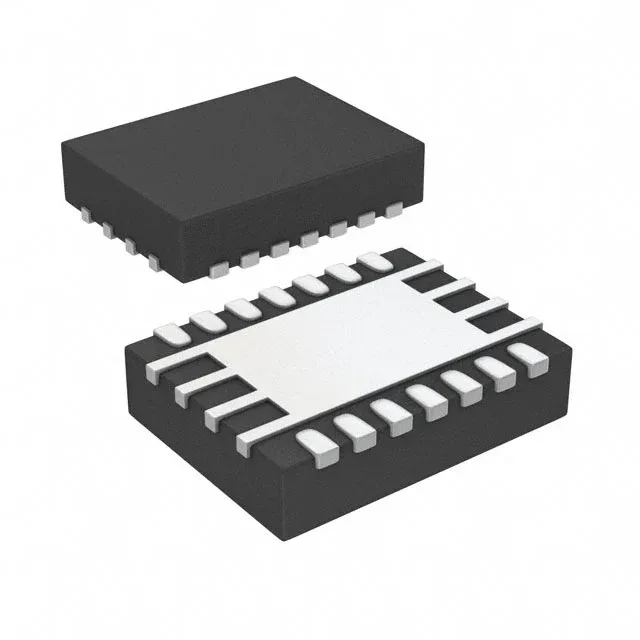
Automotive buck-boost for battery-powered ECUs
The Texas Instruments TPS63020QDSJRQ1 is an AEC-Q100 qualified buck-boost switching regulator that delivers up to 3.5A on the internal switch from a 1.8V to 5.5V input rail. Its single-inductor topology with synchronous rectification maintains regulation when the input voltage crosses the output set point — critical for automotive modules that must ride through cranking events or operate from a Li-ion backup cell.
3.5A switch at 125°C junction — derating reality
The 3.5A switch rating is the peak inductor current limit at 25°C. At 125°C junction the current limit drops approximately 20% due to the Rds(on) increase in the internal NMOS and PMOS switches. For a 2A continuous output at 3.3V from a 3.6V input, the junction temperature stays under 100°C with the exposed pad soldered to a 1 oz copper plane on a 4-layer board.
Adjustable output and loop compensation
The output is adjustable from 1.2V to 5.5V via an external resistor divider. The feedback node sits at 500 mV typical, so the divider current is set by the top resistor — 100 kΩ keeps the feedback current under 5 µA without compromising noise immunity. The internal compensation is optimised for a 2.2 µH inductor and 10 µF output capacitor, so the BOM changes only the feedback resistors to hit the target voltage. No external compensation network means fewer passives on the automotive bill.
The base product number TPS63020 shares the same die and package across commercial and automotive grades, so production volume is consolidated and unlikely to go EOL without a long lead-time notification. For dual-source planning, the non-automotive TPS63020DSJR (same 14-VSON package, same pinout) is a functional alternative where AEC-Q100 qualification is not required — but the QDSJRQ1 variant is the one to specify for any automotive PPAP submission.