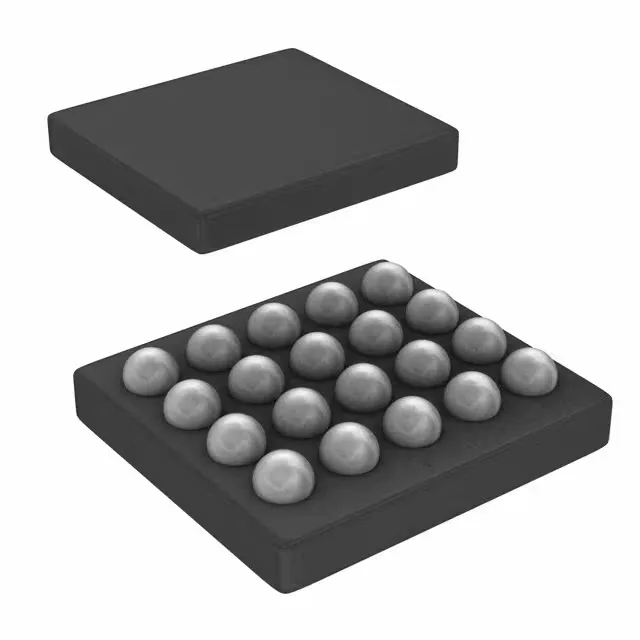
The TPS63011YFFR is a synchronous buck-boost converter from Texas Instruments that regulates a programmable output from an input spanning 2 V to 5.5 V. The 2.4 MHz switching frequency lets the designer use small inductors (typically 1 µH to 2.2 µH) and ceramic capacitors, keeping the total solution footprint compact.
Programmable output and synchronous rectification
The output voltage is programmable, with fixed options of 2.8 V and 3.3 V noted in the ordering information. Synchronous rectification eliminates the external Schottky diode, improving efficiency at light loads and reducing BOM count. The positive output configuration and single-output topology suit point-of-load regulation for RF transceivers, sensor modules, and portable instruments.
20-DSBGA package — board-level reality
The 20-DSBGA (0.4 mm pitch wafer-level chip-scale package) occupies about 2.2 mm × 2.3 mm on the board, but the fine pitch demands careful PCB layout: via-in-pad with filled and capped vias, a solder-mask-defined pad, and a stencil aperture sized for the 0.25 mm ball diameter. The small footprint is an advantage in space-constrained designs, but the reflow profile must follow TI's DSBGA guidelines to avoid head-in-pillow defects.