What this 15A automotive buck does for your power rail
The output is programmable from 0.4V up to 3.35V, which covers the core voltages of modern SoCs, FPGAs, and DDR memory terminations. The switching frequency can be set to 1.5 MHz, 2.25 MHz, 2.5 MHz, or 3 MHz, letting the designer pick between smaller magnetics (higher frequency) or better efficiency (lower frequency).
Sizing the 15A output against the thermal budget
At 15A output, the TPS62873Y1QWRXSRQ1 delivers five times the current of the LMR33630APCQRNXRQ1 (3A) and nearly three times the LMS3655MQURNLRQ1 (5.5A) in the same automotive AEC-Q100 family. Unlike the LM53625LQURNLRQ1 which offers a fixed 5V output, this part's programmable output (0.4V to 3.35V) gives flexibility for sub-1V core rails. The synchronous rectifier is integrated, so no external Schottky diode is needed, saving BOM cost and board area.
For production planning, the base product number TPS62873 covers multiple output-current and package variants. Confirm the specific suffix (Y1QWRXSRQ1) for the 15A version in the 16-VQFN wettable-flank package.
Wettable-flank package for automated inspection
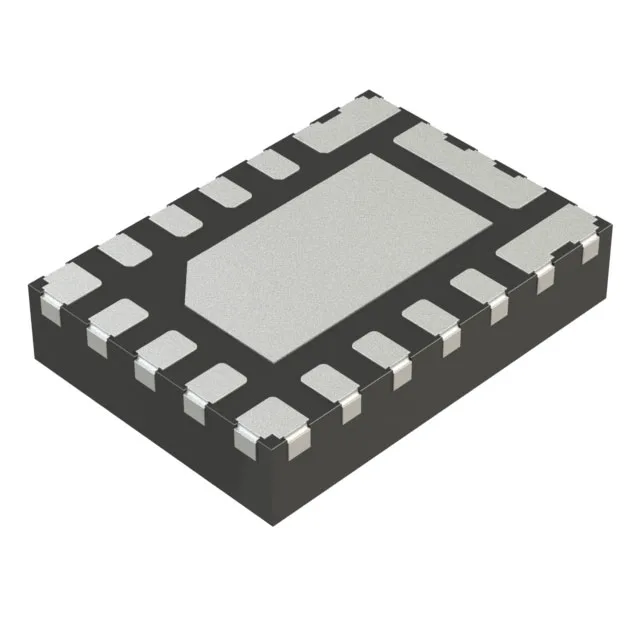
The 16-TFQFN package with exposed pad uses wettable flanks — the side of each terminal is plated so that solder wicks up the edge. This allows automated optical inspection (AOI) of the solder joints, a requirement in automotive production lines where hidden QFN joints are otherwise unverifiable. The supplier device package is 16-VQFN (2.55x3.55 mm). The input voltage range (2.7V to 6V) means it can run from a 3.3V or 5V rail directly, or from a single-cell Li-ion battery.