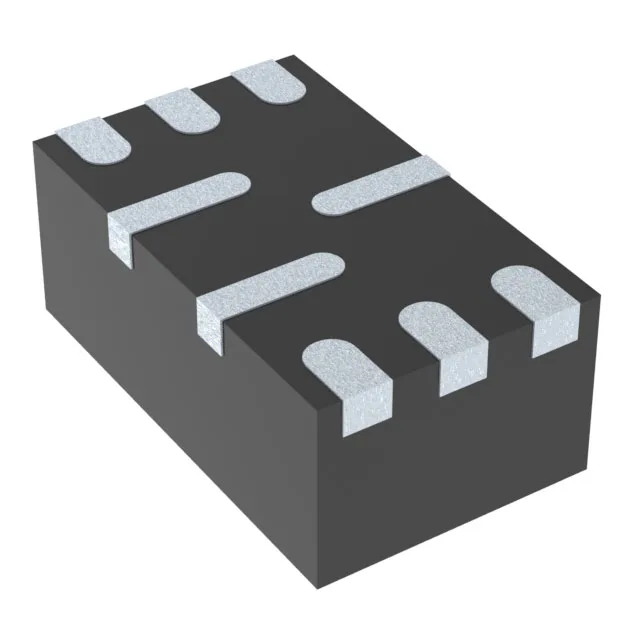
What this 6 A buck regulator delivers for a point-of-load rail
That 6 A rating in a 9-VQFN-HR package means it can power a processor core, FPGA rail, or a cluster of peripheral loads without an external heatsink — as long as the layout pulls heat into the PCB copper plane under the exposed pad. Switching at 2.4 MHz lets the designer pick a small inductor — typically 0.47 µH to 1 µH — and keep the output ripple under 10 mV with ceramic output caps. The trade-off: the fast switching edge demands a tight power loop from input cap to inductor to output cap, with the switch node kept short to minimise radiated noise.
Input range and output adjustability — fitting the rail
The input range spans 2.4 V to 5.5 V, covering single-cell Li-Ion, 3.3 V, and 5 V buses. The output is adjustable from 0.8 V up to 5.5 V, set by a resistor divider on the FB pin. For a 1.8 V or 3.3 V rail, the feedback resistors are straightforward; for a sub-1 V core rail, the divider ratio pushes the upper resistor into the tens of kΩ range, which keeps the feedback node impedance manageable. The positive output configuration means the regulator sources current only — no sinking — so it's a straight step-down, not an inverting or SEPIC topology.
Temperature grade and layout reality for the 9-VQFN
A 2-layer board with a solid ground plane under the pad will keep the junction below 125°C at 6 A if the input-to-output differential is under 1.5 V; at higher differentials, a 4-layer board with thermal vias is the safer bet. Sourced through our distribution channel; confirm the BOM quantity and preferred package format at quote time.