1 A automotive buck for tight spaces
The Texas Instruments TPS628112MQWRWYRQ1 is a synchronous step-down (buck) converter in the Automotive, AEC-Q100 series, delivering a fixed 1.8 V output at up to 1 A from a 2.75 V to 6 V input rail. It integrates the switching FETs and synchronous rectifier, so the only external components needed are the inductor, input/output caps, and feedback-loop compensation is internal — no external RC network to tune. The 1.8 MHz to 4 MHz switching frequency range lets you shrink the inductor to a 1 µH or 2.2 µH footprint, which matters when you're squeezing a point-of-load rail into an ECU or sensor module that already has a 12 V battery feed.
125°C ambient — under-hood ready
The 125°C ceiling covers most automotive under-hood zones; if your design needs 150°C junction temperature, you'd step up to a part like the LM53625LQURNLRQ1 which is rated to 150°C (TJ). The synchronous rectifier keeps efficiency in the high 80s to low 90s across the 1 A load range, which helps keep the junction temperature rise manageable in a 3 mm x 2 mm QFN.
Wettable flank package for AOI
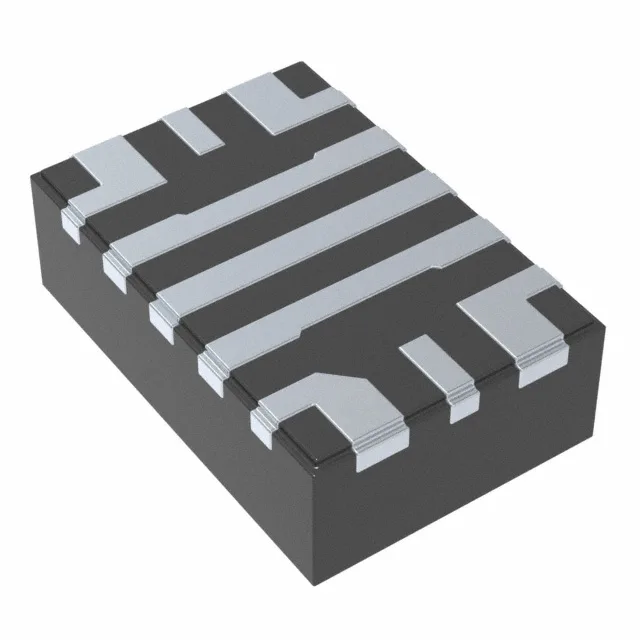
The 9-VQFN-HR (3x2) package includes wettable flanks on the side of the leads, which means an automated optical inspection (AOI) system can verify solder-joint fillet formation after reflow. That's a production-line requirement for many automotive Tier-1s — without wettable flanks you'd need X-ray to confirm the hidden QFN joints.
Lifecycle — active, no LTB risk
The base product number TPS628112 covers multiple fixed-output voltage variants (1.8 V here, others at 1.2 V, 1.5 V, 3.3 V) in the same footprint, so if a future BOM rev needs a different output voltage, the PCB layout stays the same.