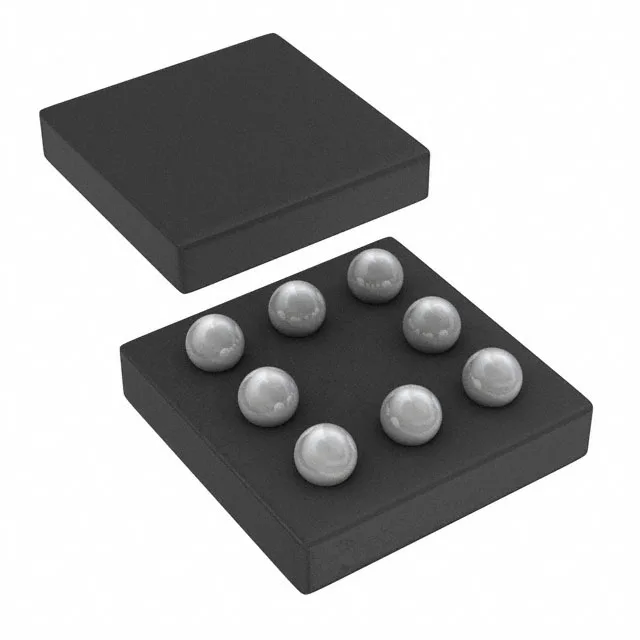
RF PA bias supply in a BGA
The TPS62700YZFR is a dedicated step-down converter from Texas Instruments, designed specifically to bias RF power amplifiers from a 2.5V to 6V input rail. Its adjustable output from 1.3V to 3.09V covers the common PA drain supply voltages used in cellular, WLAN, and IoT transmitters. Housed in an 8-DSBGA (0.5mm pitch, 1.6mm x 1.6mm body), this part is a surface-mount device intended for compact RF front-end modules where board area is at a premium.
Adjustable output — what it buys the RF chain
The 1.3V to 3.09V output window is set by a single feedback resistor divider. This lets a designer dial in the exact PA supply voltage — 1.8V for a low-power FEM, 2.5V for a mid-range WLAN PA, or 3.0V for a cellular PA — without swapping the regulator IC. The single-output topology keeps the BOM simple: one inductor, two caps, two resistors. Input range from 2.5V to 6V means it runs cleanly from a 3.3V or 5V system rail, or from a single Li-ion cell down to about 2.5V. Below that threshold the converter drops out — not a part for a cell that discharges to 2.0V.
8-DSBGA layout reality
The 8-DSBGA package uses 0.5mm ball pitch on a 1.6mm x 1.6mm body. That pitch forces via-in-pad or microvia fan-out on a 4-layer board — two-layer designs struggle to break out all eight balls without necking the traces below the fab minimum. The supplier device package is 8-DSBGA, identical to the case code; no thermal pad on the underside, so all heat sinks through the solder balls and board copper.