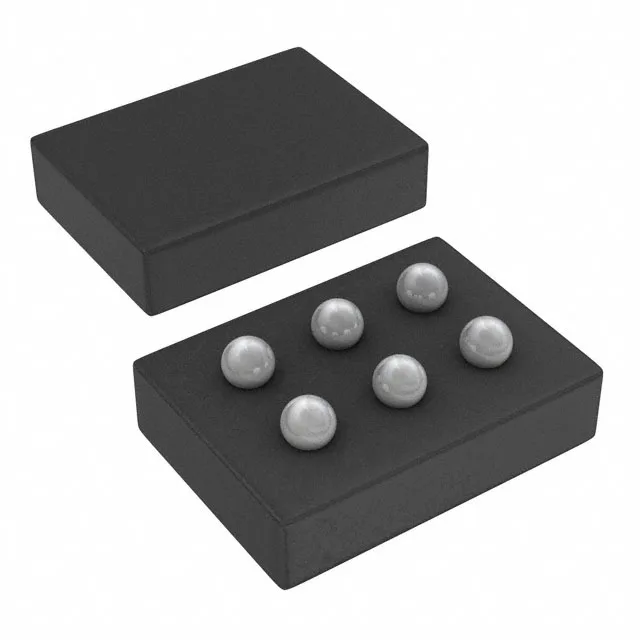
650 mA, 6 MHz synchronous buck in a 6-DSBGA package
The Texas Instruments TPS62675YFDT is a step-down (buck) switching regulator delivering a fixed 1.2 V output at up to 650 mA from an input range of 2.3 V to 4.8 V. Its 6 MHz switching frequency allows the use of small-value inductors and capacitors, which together with the 6-DSBGA package (1.5 mm × 1.0 mm typical) makes this part a fit for space-constrained portable and battery-powered designs.
The 6 MHz switching frequency is the key enabler for a compact power stage. Inductor values in the 470 nH to 1 µH range are practical, and output capacitors can be 4.7 µF or smaller ceramic types. This directly reduces footprint and height compared to a 1 MHz or 2 MHz converter. The trade-off is higher switching losses at light load, but for a 650 mA part the efficiency at moderate loads is typically above 85% — the exact curve depends on input voltage and inductor selection. The fixed 1.2 V output simplifies feedback routing: no external resistor divider is needed.
The ROHS3 compliance covers the current regulatory requirements for most markets.
The 6-DSBGA (6-ball, 0.5 mm pitch) package demands careful PCB layout. The small ball size and pitch mean the solder-paste stencil aperture and reflow profile must follow TI's application note for DSBGA packages. Thermal dissipation is limited by the package's small size — at full 650 mA load, the junction temperature rise needs to be calculated against the board's copper area. The synchronous rectifier helps keep heat down, but a continuous 650 mA at high ambient (85°C) leaves little margin. For lower-power duty-cycled applications the package is well suited.