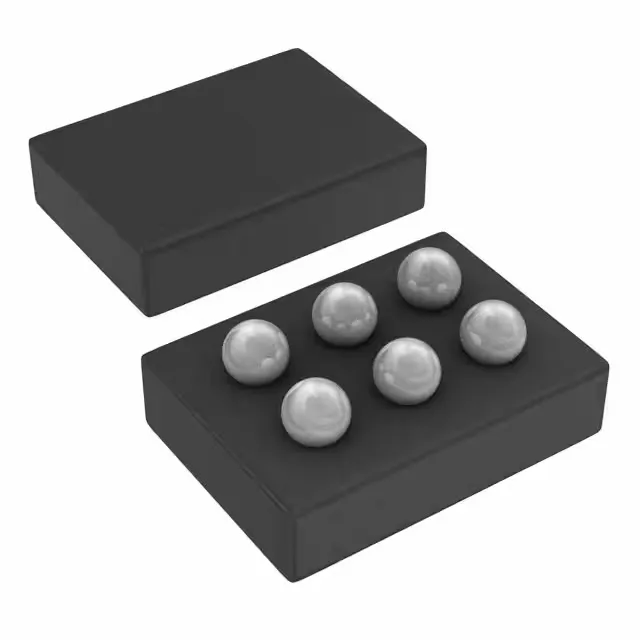
Texas Instruments TPS62625YFFR — DC-DC Power Modules

TPS62625YFFR 6 MHz Buck Converter, 600 mA, 6-DSBGA

MPNTPS62625YFFR
Active

Texas Instruments TPS62625YFFR, step-down buck converter, 2.3-5.5V input, 600 mA output, 6 MHz switching frequency, fixed 1.2 V output, synchronous rectification, 6-DSBGA package, -40 to 85 °C.

$0.6960Ref. price · indicative, final on quote
Independent supplier — new & surplus stockAuthenticity-screened · ESD-safe packingListing updated Jul 2026

Specifications

TPS62625YFFR specifications
ParameterValue
Output typeFixed
MountingSurface Mount
Voltage - input5.5V
Voltage - output (Min (Fixed))1.2V
Output current600mA
Frequency - switching6MHz
I/O channels1
Operating temperature-40°C~85°C(TA)
PackageTape & Reel (TR); Cut Tape (CT)
FunctionStep-Down
TopologyBuck
Case6-UFBGA, DSBGA
Output configurationPositive
Synchronous rectifierYes

Product details

6 MHz switching — inductor shrinks to 1 µH or less

The TPS62625YFFR is a 6 MHz fixed-frequency synchronous step-down converter from Texas Instruments. That switching speed is the key enabler: the inductor value drops into the sub-1 µH range, and the output capacitor can be a single 4.7 µF ceramic. The total solution fits in roughly 10 mm² of board area — useful when the PCB real estate is tight around a wireless SoC or a sensor module.

600 mA output — enough for the core rail

Rated for 600 mA continuous output at a fixed 1.2 V. That current ceiling covers a single-core Cortex-M4, a Bluetooth LE radio, or a small FPGA core supply.

Input range and package — what to watch on the board

The 6-bump DSBGA package (0.4 mm pitch) demands a controlled SMT profile — the solder paste volume and reflow ramp need tuning for the small bumps. A micro-via fan-out under the package is typical; the board house must support 0.2 mm via diameter. No exposed thermal pad — the die heat conducts through the bumps into the PCB copper planes.

For a production BOM that already uses this regulator, the supply outlook is stable.

Frequently asked questions

What is the difference between TPS62625 and TPS62620?

The TPS62625 outputs a fixed 1.2 V, while the TPS62620 outputs a fixed 1.8 V. The only parametric difference is the output voltage set point — the rest of the BOM (inductor, capacitors) is identical.