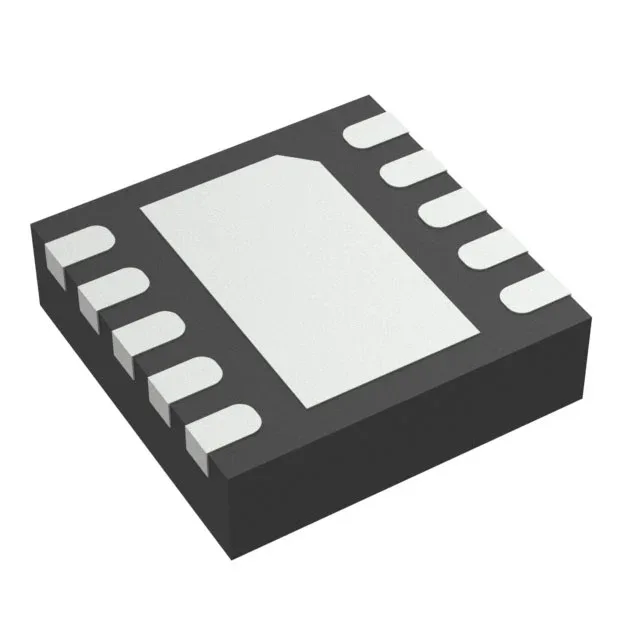
1.5 A synchronous buck in a 3x3 mm VSON
The Texas Instruments TPS62510DRCT is a 1.5 A synchronous step-down (buck) converter with an adjustable output from 0.6 V up to the input rail. It integrates the high-side and low-side MOSFETs, so no external Schottky catch diode is needed — the synchronous rectifier handles the freewheeling current internally. The 1.5 MHz fixed switching frequency keeps the inductor and output capacitors small, typically a 2.2 µH inductor and 10 µF ceramic output cap fit the compensation. This package suits compact portable devices where board area is tight, such as wireless modules, handheld instruments, and battery-powered IoT endpoints.
Input rail and output range — what fits
This covers single-cell Li-ion (3.0 V to 4.2 V), two-cell alkaline (2.4 V to 3.0 V), and fixed 3.3 V intermediate rails. It does not accept 5 V inputs — the 3.8 V maximum is a hard ceiling, so do not use it on a 5 V bus without a front-end regulator. Output is adjustable from 0.6 V to 3.8 V via an external resistor divider. The 0.6 V reference allows generation of low core voltages for modern MCUs and FPGAs. The single output delivers up to 1.5 A continuous; the current limit is typically 2.4 A peak.
This is the industrial temperature range — suitable for outdoor telecom cabinets, factory-floor sensors, and commercial battery-powered gear.
No official successor or pin-compatible second-source alternate is listed on the TI cross-reference — the TPS62510 family is a single-source design, so dual-sourcing requires a separate qualification effort on a different regulator.