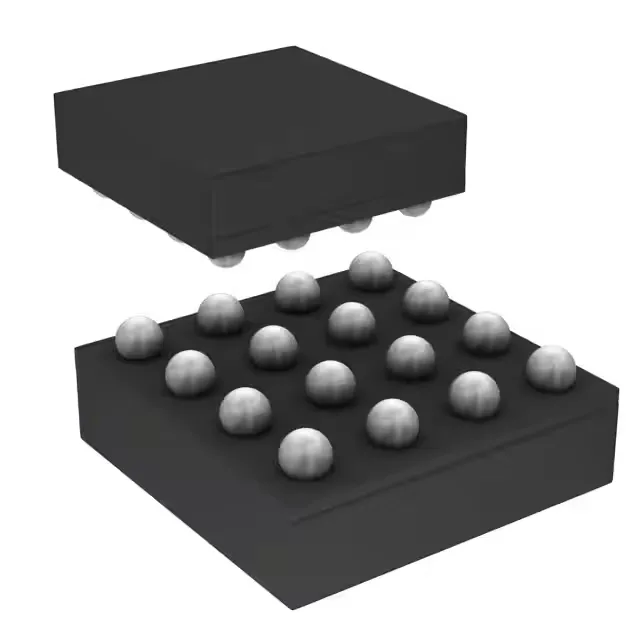
DCS-Control buck for processor core rails
The Texas Instruments TPS62366BYZHR is a 2.5A step-down buck converter built around the DCS-Control™ topology — a hybrid voltage-mode / hysteretic architecture that delivers fast transient response without requiring external compensation components.
2.5A output at 2.5MHz — inductor and cap sizing
Rated for a continuous 2.5A output, this part handles the core supply for a mid-range SoC or FPGA auxiliary rail. The 2.5MHz switching frequency pushes the inductor value down to the 0.47 µH to 1.0 µH range, with output capacitance typically 10 µF to 22 µF. That keeps the total passive footprint under 12 mm², which matters when the board area is set by the battery or enclosure outline. The input range spans 2.5V to 5.5V, covering single-cell Li-ion, 3.3V, and 5V rails. The adjustable output goes from 0.5V up to 1.77V, with fixed-voltage options at 0.96V and 1.4V selectable via the VSEL pin — no external divider needed for those common core voltages.
16-DSBGA — layout and thermal reality
The 16-DSBGA package measures 2.24 mm × 2.16 mm with a 0.50 mm ball pitch. That is a fine-pitch BGA — the board requires a 4-layer stack-up with microvias or laser-drilled vias under the package to route the power and ground balls. The synchronous rectifier is integrated, so no external Schottky diode is needed.