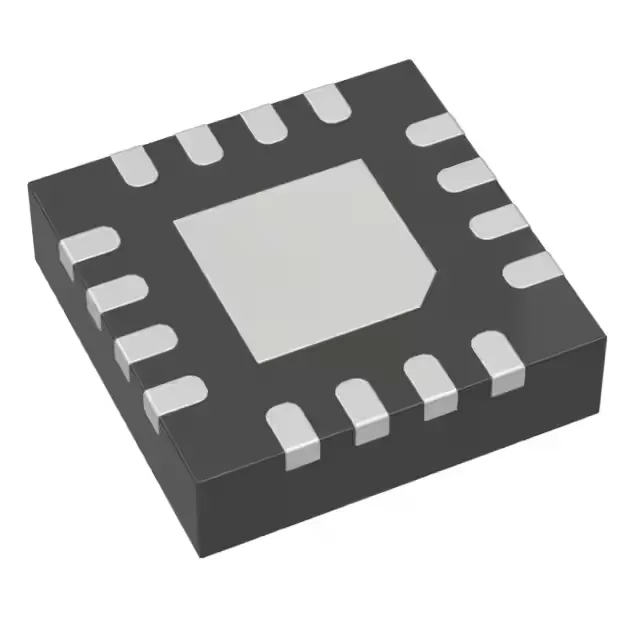
3A output at 2.8 MHz — what it buys the power rail
The TPS62090RGTT is a 3A continuous step-down buck converter from TI's DCS-Control family, switching at 2.8 MHz. The high switching frequency shrinks the inductor and output capacitor to a few mm² footprint, while the DCS-Control hysteretic architecture delivers load-transient recovery in a few switching cycles without external compensation components. The adjustable output starts at a 0.8 V minimum reference, suiting it for low-voltage core rails in FPGAs, MCUs, and SoCs.
Switching frequency and loop stability
At 2.8 MHz, the switching frequency stays above the AM radio band and keeps ripple well within 10 mVpp with a 1 µH inductor and 22 µF output cap. The DCS-Control scheme combines voltage-mode feedforward and current-mode hysteretic control, giving near-instantaneous response to load steps without the phase-margin headaches of Type-III compensation.
Package and thermal: 16-VQFN (3x3)
The copper area on the bottom layer directly sets RthJA — a 1 in² pour drops it to about 40 °C/W, enough for 3 A at 85 °C ambient with 90% efficiency.
Synchronous rectification and efficiency
The 3 A rating is continuous; peak current limiting protects the inductor and output cap during startup or fault conditions.