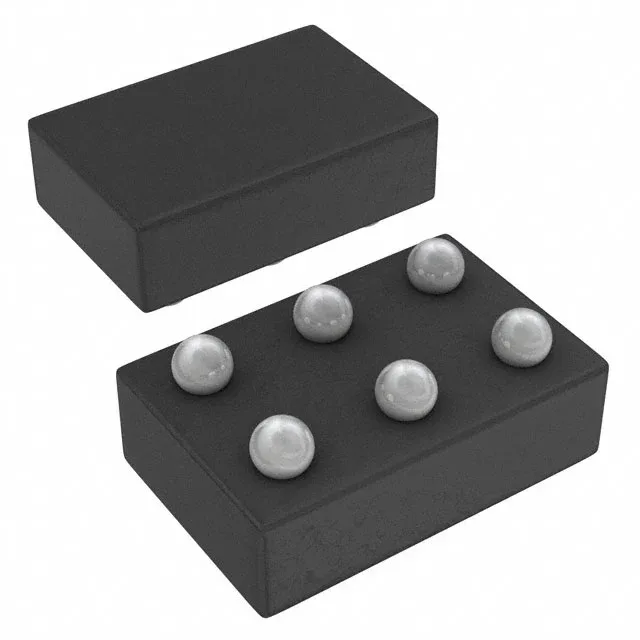
Texas Instruments TPS6208812YFPR — Power Management (PMIC / Gate Driver)

TPS6208812YFPR 3 A Step-Down Buck Regulator, DCS-Control

MPNTPS6208812YFPR
Active

Texas Instruments TPS6208812YFPR, DCS-Control™ series, synchronous step-down buck regulator, 3 A output, 4 MHz switching, fixed 1.2 V output, 6-DSBGA package, -40 to 125°C.

$0.8415Ref. price · indicative, final on quote
Sourced new & surplus through independent channelsAuthenticity-screened · ESD-safe packingListing updated Jul 2026

Specifications

TPS6208812YFPR specifications
ParameterValue
SeriesDCS-Control™
Output typeFixed
MountingSurface Mount
Voltage - input5.5V
Voltage - output (Min (Fixed))1.2V
Output current3A
Frequency4MHz
I/O channels1
Operating temperature-40°C~125°C(TJ)
PackageTape & Reel (TR)
FunctionStep-Down
TopologyBuck
Case6-XFBGA, DSBGA
Output configurationPositive
Synchronous rectifierYes

Product details

The TPS6208812YFPR is a 3 A synchronous step-down converter from TI's DCS-Control family, packing the full output stage into a 6-DSBGA package that measures about 1.5 mm × 1.5 mm. That 3 A rating is real continuous output, not a pulse peak, and the 4 MHz switching frequency lets you get away with a 0.47 µH inductor and a 10 µF output cap — small enough to fit the whole supply on the back of a sensor board or inside a connector housing.

Output is fixed at 1.2 V, so this is a drop-in for any 1.2 V core or I/O rail — no feedback divider to populate or trim. The synchronous rectifier is integrated, so no external Schottky diode is needed, and the DCS-Control loop keeps the output within regulation during load steps without the output overshoot you see on fixed-frequency PWM parts at light load.

TI lists this part as Active on the product status.

Industrial temp grade, small footprint

The 6-DSBGA package has a 0.5 mm pitch — a standard 4-layer PCB with micro-vias will fan it out; a two-layer board needs careful trace routing under the BGA to keep the inductor loop tight. No special ESD handling beyond normal CMOS precautions, but the small pads mean a hot-air rework station is the right tool for a field swap, not a soldering iron.

Frequently asked questions

Can TPS6208812YFPR replace TPS6208811YFPR?

The TPS6208811YFPR is a sibling in the same DCS-Control family with a different fixed output voltage. The 12 suffix here means 1.2 V output. If the 11 variant is a different voltage (e.g., 1.1 V or 1.8 V — check the specific order code), the two are not drop-in replacements without adjusting the load. Pin-compatible across the fixed-voltage options in the TPS620881x family, but the output rail must match your load.

What is the typical efficiency of TPS6208812YFPR?

Efficiency data is in the datasheet — typical curves show above 90% at moderate loads (500 mA to 2 A) from a 3.6 V input at 1.2 V output, thanks to the DCS-Control architecture that maintains high efficiency across load range. Exact figures depend on the inductor and output capacitor selection.

Can TPS6208812YFPR be used in battery-powered applications?

Yes — the 2.4 V minimum input covers a single Li-Ion cell down to near its discharge cutoff, and the DCS-Control topology keeps quiescent current low at light loads, which is critical for extending battery life in always-on sensor nodes or portable devices.