Single-cell boost to 3.3V — the 0.9V minimum input is the headline
The TPS613221ADBVT is a synchronous step-up converter that starts from an input as low as 0.9V and delivers a fixed 3.3V output — meaning it can run a 3.3V rail from a single alkaline cell that's nearly dead, or from a Li-ion cell across its full discharge curve down to the undervoltage lockout threshold. The internal switch is rated for 1.6A peak current, so the output can source a couple hundred mA at 3.3V from a single cell — enough for a Bluetooth module, a sensor node, or a small MCU plus radio burst.
Switching frequency range and inductor choice
The oscillator runs between 500 kHz and 2 MHz, which lets you trade inductor size against switching losses. At 2 MHz the inductor can be a 1 µH chip — good for a compact BOM in a wearable or IoT dongle. Dropping to 500 kHz buys a couple points of efficiency at the cost of a physically larger 4.7 µH or 10 µH part. Synchronous rectification is built in, so you do not need an external Schottky catch diode. That saves a component and keeps the efficiency curve flatter across load, especially below 100 mA where a diode's forward drop would hurt.
Temperature range and package for tight boards
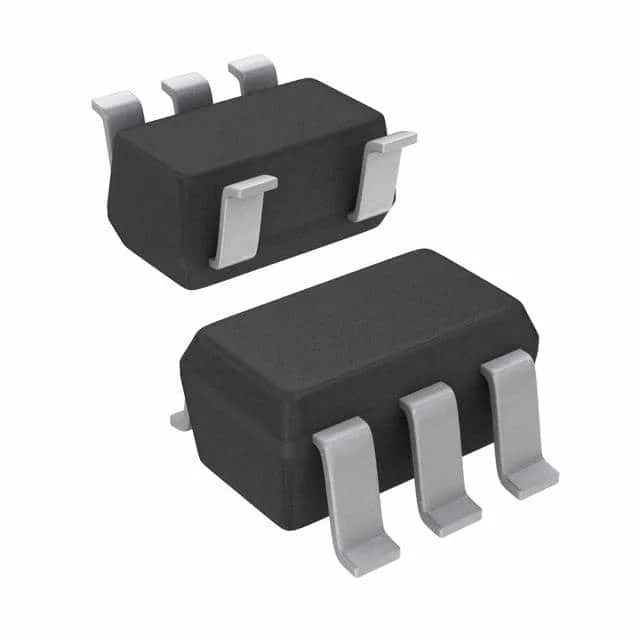
It comes in a 5-pin SOT-23 (SC-74A) package — the same footprint as countless other small regulators, so the board layout is straightforward and the pick-and-place cost is minimal.
Active production — no obsolescence worry for new designs
For a new BOM this is a safe selection — no need to plan a migration path yet. The base product number is TPS613221, so if you need a different fixed output voltage or a different switching frequency variant, the family shares the same pinout and package.