Boost regulator for camera flash — three-channel I²C driver
It integrates three current-sink outputs, each capable of 400 mA in torch mode and 800 mA in flash mode, with the total flash current programmable via the I²C interface.
Input range and output voltage — Li-ion to 5.7 V rail
The regulated output is fixed at 5.7 V, a common voltage for series-connected flash LEDs that need headroom above the forward-voltage stack.
Switching frequency and inductor selection
The 1.92 MHz switching frequency lets the designer use a small inductor — typically 1 µH to 2.2 µH — which keeps the total solution height low for slim phone or camera modules. The frequency also places the fundamental ripple above the audio band, so the inductor does not whine audibly during torch operation.
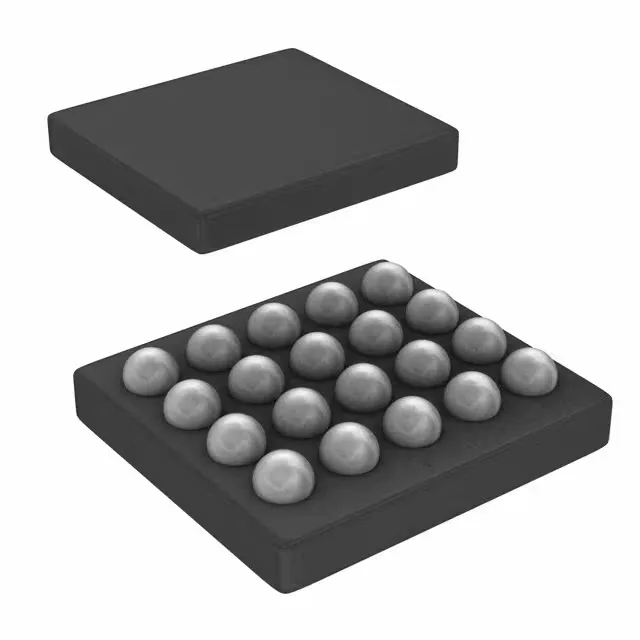
Package and layout — 20-bump DSBGA
The small footprint — roughly 1.6 mm × 2.0 mm — saves board area but demands careful decoupling placement; the input and output capacitors should sit within 2 mm of their respective bumps to keep switching loops tight.