Boost regulator for camera flash with I²C dimming
It integrates three outputs with internal switches, eliminating the need for external MOSFETs in the power stage. Dimming is handled via I²C interface, allowing the host processor to set flash current and torch current programmatically. The switching frequency is fixed at 1.92MHz, which keeps the inductor and output capacitors small enough for a compact phone or module layout.
The output is regulated to 5.7V, which is the typical forward voltage ceiling for a series string of two white LEDs in a flash module. The current per channel is 400 mA continuous (torch) and 800 mA in flash mode — enough to drive a dual-LED flash at full brightness. The input supply range is 2.5V to 5.5V, so it works directly from a single-cell Li-ion battery (2.7V to 4.2V typical). The boost topology steps up from battery voltage to the 5.7V rail with the efficiency you expect from a modern integrated switcher.
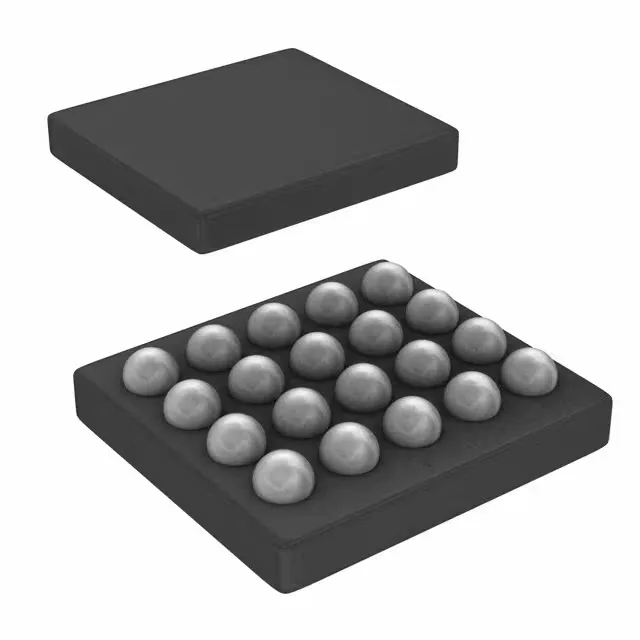
The TPS61300YFFR is housed in a 20-pin DSBGA (0.4 mm pitch) package — the same footprint as the 20-UFBGA listed in the package/case field. The small ball pitch and 0.5 mm overall package height suit space-constrained camera modules or handheld devices. The surface-mount package requires standard reflow soldering; no special handling beyond the usual MSL precautions for a BGA.