Fixed 5.4V boost for battery-powered rails
The Texas Instruments TPS612564CYFFR is a fixed-output step-up (boost) converter that delivers a regulated 5.4V rail from a 2.3V to 5.5V input source. This makes it a direct fit for generating a 5V USB or logic supply from a single-cell Li-ion battery (3.0V–4.2V) or from 2–3 alkaline/NiMH cells, where the 2.3V minimum input allows operation even as the battery nears end-of-discharge.
At a 5.4V output, this translates to roughly 1.5–1.8A of continuous output current, depending on input voltage and inductor selection. That's enough headroom to power a Raspberry Pi Zero, a string of high-power LEDs, or a small sensor hub without needing an external FET.
3.5 MHz switching — small inductor, tight layout
The trade-off is higher switching losses, but for battery-powered designs where PCB area is the tighter constraint, this is the right balance. The synchronous rectifier improves efficiency at light loads by replacing the catch diode with a low-Rds(on) FET.
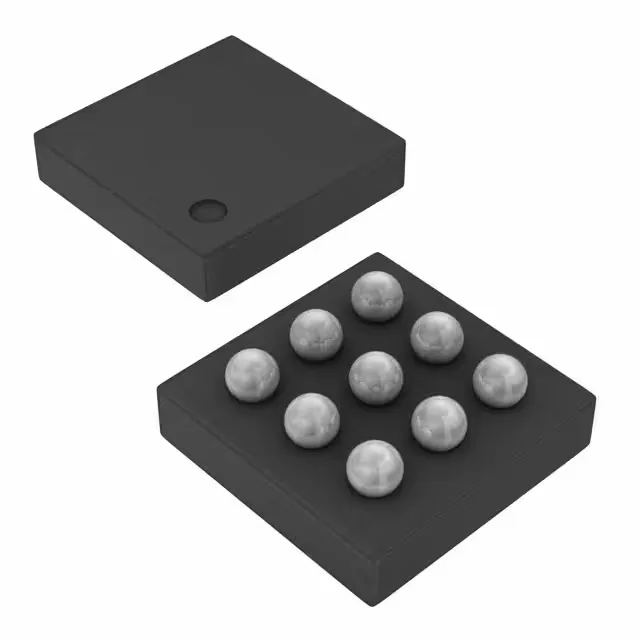
9-DSBGA package — rework and layout notes
The 9-DSBGA (0.4 mm pitch, 0.25 mm ball diameter) is a wafer-level chip-scale package. It requires a clean solder-paste stencil and a reflow profile matched to the JEDEC MSL-1 moisture sensitivity. The small ball pitch means the PCB pad design must follow TI's recommended land pattern exactly — no via-in-pad without tenting, and the output capacitor should sit within 2 mm of the package to keep the switch-node loop tight.