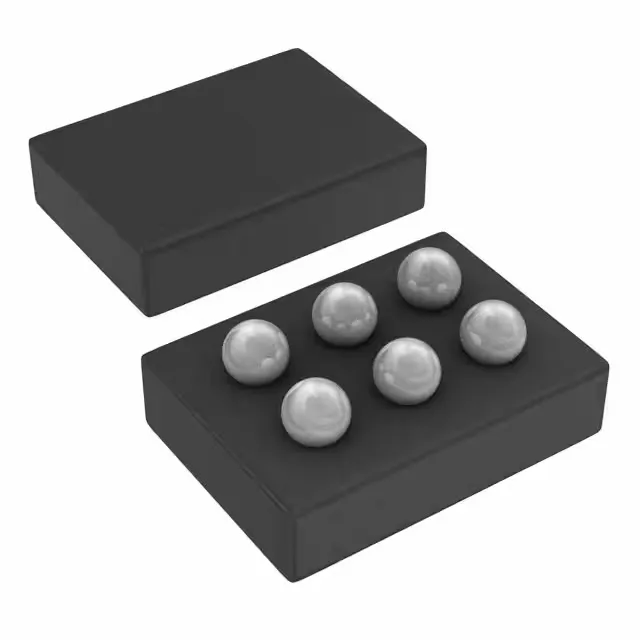
Fixed 5 V boost in a 1.5 mm² footprint
It integrates a 500 mA switch and operates at a 3.5 MHz switching frequency, which keeps the inductor and capacitors small enough to fit alongside the 6-pin DSBGA package on a tight PCB.
500 mA switch current — sizing the load
The 500 mA switch current limit defines the peak inductor current the part can handle. For a 5 V output from a 3.6 V Li-ion cell, expect around 300 mA to 350 mA of continuous output current before the switch hits its limit — enough to power a small sensor module, a Bluetooth LE radio, or a single USB peripheral.
3.5 MHz switching — small passives, clean rail
The 3.5 MHz switching frequency pushes the ripple into the low-MHz band, so a 1 µH inductor and 4.7 µF output capacitor are typically enough to hold the output ripple under 20 mV. That small LC pair fits in a 2×2 mm footprint, matching the DSBGA's own scale.