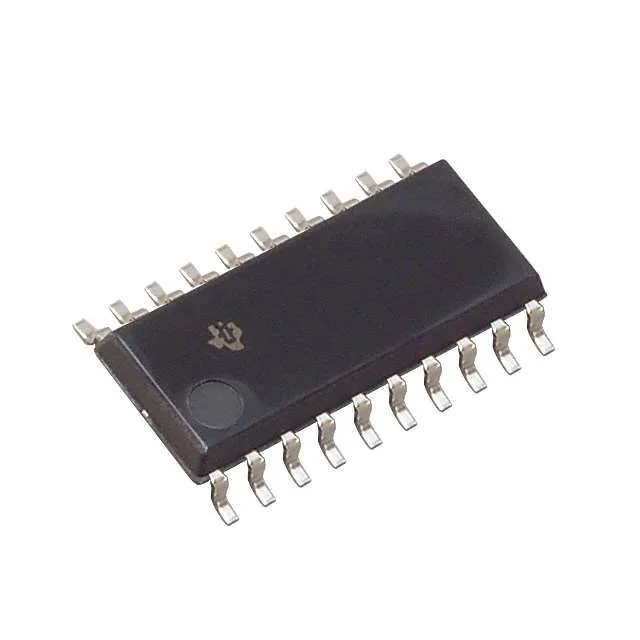
Boost controller for multi-string LED backlights
The TPS61199NSR is a DC-DC boost controller from Texas Instruments designed for driving LED backlight strings in LCD panels. It integrates eight current-sink outputs, each rated for 70 mA, and uses an external switching FET — the controller handles the regulation loop while the designer selects the MOSFET for the target power level. Switching frequency is programmable between 500 kHz and 800 kHz via a single resistor, letting the designer trade inductor size against switching losses.
PWM dimming and channel matching
Dimming is handled via a PWM input on the controller, which modulates the LED current on/off at the applied duty cycle. This avoids the colour shift that analogue dimming introduces, making the part a fit for display backlights where colour consistency across brightness levels matters. The eight current-sink outputs are matched to within a few percent, so each LED string in a multi-string backlight carries the same average current. Uneven brightness between strings is visible as banding on the panel — the TPS61199NSR's channel matching eliminates that artifact without per-string trimming.
20-SOIC package and external switch
The controller comes in a 20-pin SOIC (0.209-inch body width, 5.30 mm tall) — a surface-mount package that fits standard pick-and-place and reflow assembly. The wide-body SOIC provides adequate pin pitch for routing the boost inductor, sense resistor, and external MOSFET gate trace without a four-layer board. Because the internal switch is absent, the designer selects the external N-channel MOSFET based on the total LED string voltage and current. For a typical 8-string, 70 mA per string backlight with a 24 V LED rail, a 40 V, 2 A rated MOSFET with a gate charge under 20 nC keeps switching losses manageable at 800 kHz.