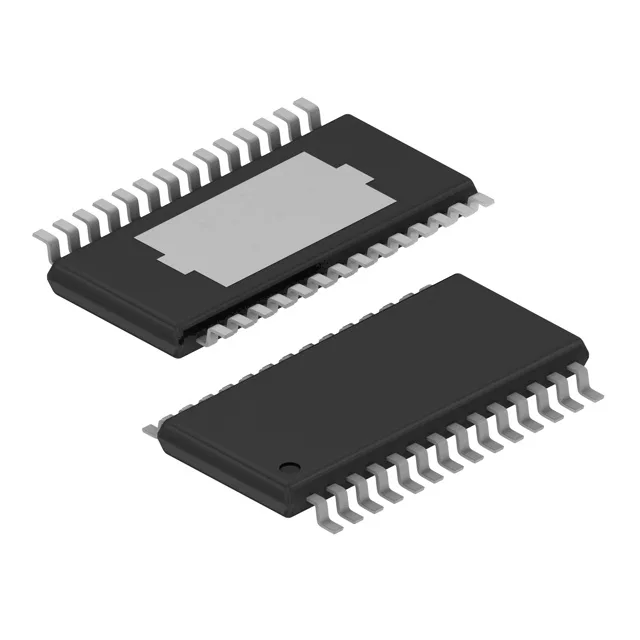
What this boost controller does — and what it doesn't
The TPS61196PWPR is a DC DC boost controller designed for backlight applications, meaning it drives external MOSFETs and inductors rather than integrating the switch internally. This gives you flexibility in the power stage — you size the external FET and inductor for the actual LED string current and voltage — but it also means the BOM includes those passives, which a monolithic regulator like the LM2703 would not need. Six independent output channels, each rated for 400 mA, allow driving multiple LED strings with individual PWM dimming. The 800 kHz switching frequency balances inductor size and switching losses.
Supply voltage and output ceiling
Input supply range is 8 V to 30 V, covering common automotive and industrial rails with margin for transients. The boost output is rated to 120 V, sufficient for series LED strings in backlight panels. Compare this to the LM2703MF-ADJ/NOPB: that is a single-channel DC DC regulator with internal switch, rated 0.35 A output, in a SOT-23 package. The TPS61196PWPR handles six times the channel count and nearly 7× the per-channel current, but it demands an external power stage and a larger 28-HTSSOP footprint. For a multi-string backlight, the TPS61196PWPR is the right architecture; for a single-string, the LM2703 may be simpler.
The 28-HTSSOP package is a mainstream PowerPAD variant.