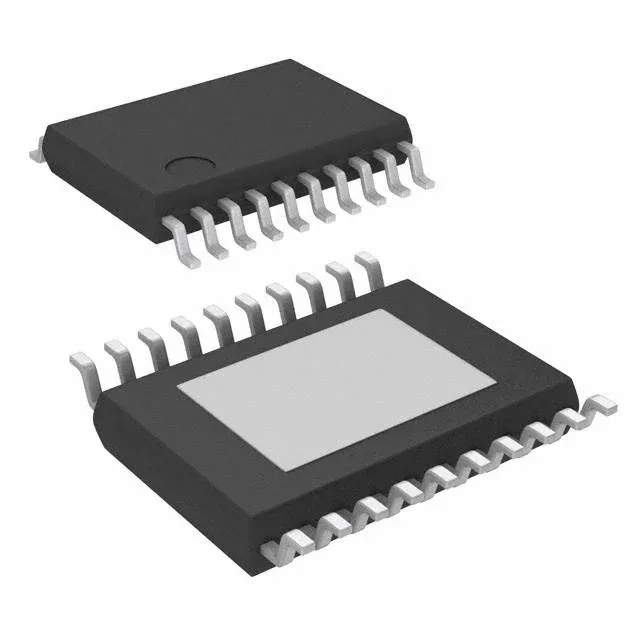
What the 45 V output and 100 mA per channel mean for your LED string
The TPS61193PWPR is a three-channel DC-DC regulator from Texas Instruments designed for LED backlight applications. Each channel delivers up to 100 mA at a maximum output voltage of 45 V, which means you can drive a string of up to 10–12 white LEDs in series per channel, depending on their forward voltage. The part uses a SEPIC or step-up (boost) topology, so it can regulate the LED current whether the input voltage is above, below, or equal to the output — a common situation in automotive and battery-powered systems where the supply rail sags below the LED string voltage.
PWM dimming and switching frequency — layout and inductor choices
Dimming is controlled via a PWM signal on the dedicated pin, giving you a linear brightness range from near-zero to full scale without color shift. The switching frequency is programmable between 300 kHz and 2.2 MHz. Running at the high end shrinks the inductor and output capacitor footprint — useful in space-constrained panel backlight PCBs — but pushes switching losses higher. At 300 kHz the efficiency peaks, but the inductor gets physically larger. The frequency is set with a single resistor to ground, so you can tune it during layout without a component change.
That covers under-hood displays, outdoor kiosk backlights, and dashboard infotainment panels where ambient heat can exceed 85°C.