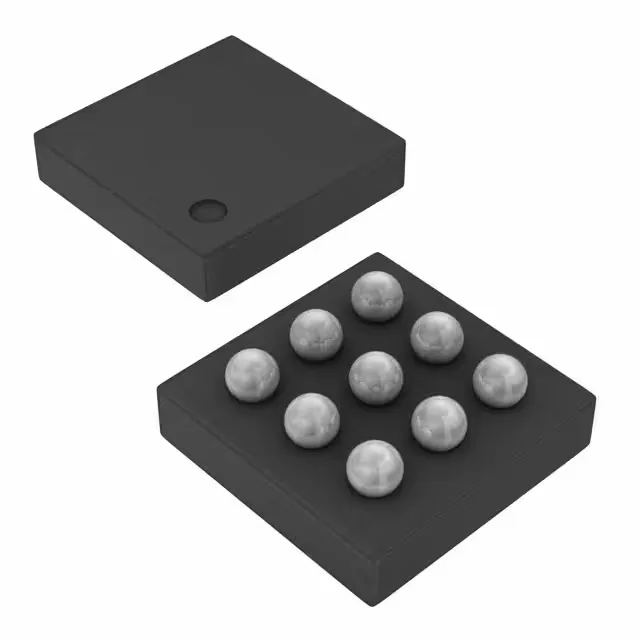
Boost regulator for dual-string LED backlight
It integrates two outputs, each capable of delivering 30 mA, with the output voltage automatically adjusting up to 27 V to match the LED forward voltage requirement. Brightness control is handled through either analog or PWM dimming, giving the design team flexibility to trade off linearity against noise immunity depending on the system architecture.
The 30 mA per-channel current rating sets the maximum LED string brightness. For a typical 10-LED string at 3 V forward drop per LED, the boost output must deliver 30 V; the TPS61162's 27 V ceiling means the practical string length is limited to eight or nine LEDs in series, depending on the LED forward voltage tolerance. Two outputs allow independent control of two LED strings, enabling split-screen backlight zones or redundant string architectures for higher reliability displays. Each output is current-regulated, so the voltage compliance adjusts automatically per string.
1.2 MHz switching frequency and package reality
The 1.2 MHz switching frequency keeps the inductor and output capacitor physically small — a 2.2 µH to 4.7 µH shielded inductor and 1 µF ceramic output cap are typical. This suits the 9-DSBGA package, which measures roughly 1.5 mm × 1.5 mm, making it viable for slim handheld devices where board area is at a premium. It requires a solder-mask-defined pad layout and a stencil aperture matched to the ball diameter. The 2.7 V to 6.5 V input supply range covers single-cell Li-ion through 5 V USB rails, so no external pre-regulator is needed for most portable applications.