Dual-channel LED backlight boost — the NRND flag matters
It integrates two 30 mA current sinks with a switching frequency of 1.2 MHz, supporting both analog and PWM dimming for flexible brightness control across a 2.7 V to 27 V output range.
That is a formal flag from TI: existing production continues but the part is no longer being designed into new products. For new designs, the prudent move is to evaluate a pin-compatible or functional replacement before the EOL notice arrives.
2-channel, 30 mA per string — split-display or dual-zone backlight
Two independent output channels, each rated at 30 mA, let the TPS61162DYFFR drive separate LED strings for dual displays (e.g. a main and sub-display in a handheld device) or split a single backlight into independently dimmable zones. The 2.7 V minimum output voltage allows operation with a single LED, while the 27 V ceiling supports up to eight or nine white LEDs in series, depending on their forward voltage.
Analog and PWM dimming on the same pin
Both analog and PWM dimming are supported, giving the design engineer two brightness-control paths without extra pin overhead. Analog dimming adjusts the LED current linearly; PWM dimming modulates the on-time for wider contrast ratios. The 1.2 MHz switching frequency keeps the inductor small — a 4.7 µH to 10 µH part is typical — and places the switching harmonics well above the audio band.
9-DSBGA footprint — board-level handling
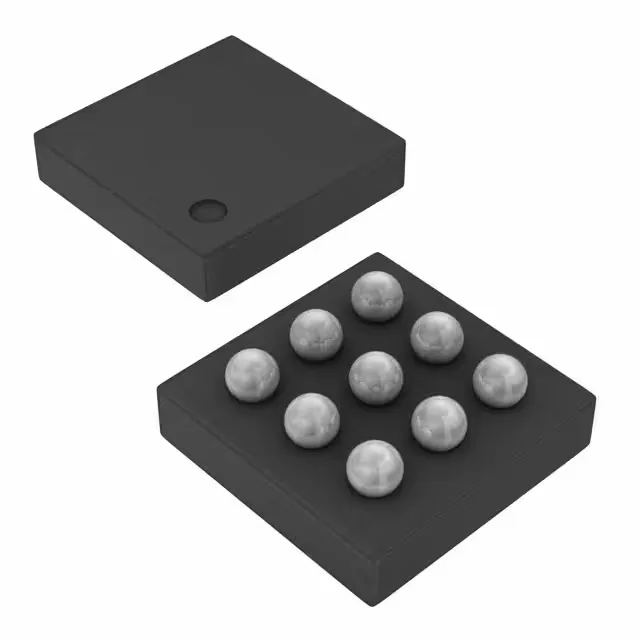
Housed in a 9-bump DSBGA package (0.4 mm pitch, 1.5 mm × 1.5 mm body). The fine-pitch BGA demands a clean solder-paste stencil and a controlled reflow profile. Moisture sensitivity level (MSL) is not stated in this record, but DSBGA packages typically require bake before reflow if the floor-life has been exceeded. The small footprint suits space-constrained portable designs but makes manual rework impractical without a hot-air station and micro-scope.