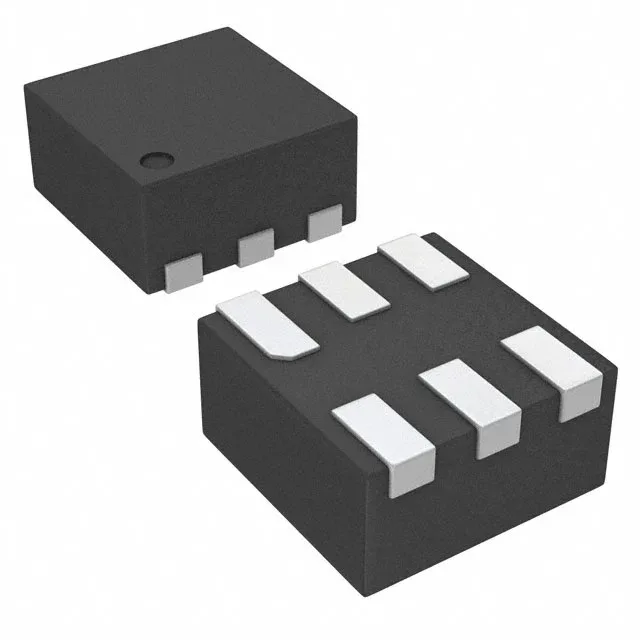
Two rails from one tiny package
The TPS610987DSET from Texas Instruments packs a synchronous boost converter and a linear LDO into a single 6-WSON package measuring just 1.5x1.5 mm. The boost output delivers 4.3V at 350 mA — enough to run a small MCU board or a wireless module — while the LDO provides a clean 2.2V rail at 200 mA for a sensor, RF front-end, or analog section that needs lower noise than a switcher can give. Input range spans 0.7V to 4.5V, so it keeps running as a single-cell alkaline battery drains down to nearly dead, and it also handles a Li-ion cell through its full discharge curve. The 0.7V minimum is the key spec for battery-portable designs — many boost converters quit below 0.9V or 1V.
A boost converter that starts up at 0.7V lets you squeeze more usable energy out of a single alkaline cell before the system browns out. The trade-off is that at very low input voltages the inductor current ramps higher to maintain the output, so the inductor saturation rating and the PCB copper pour for the switch node need attention. The 350 mA output from the boost is a continuous rating — peak inductor current will be higher during startup and transient load steps. The LDO output at 2.2V / 200 mA is a separate linear regulator, not a second switcher. That means no switching noise on that rail — useful for powering an analog microphone, a small op-amp, or a Bluetooth radio's low-noise section. The LDO's dropout voltage is not listed here, but with a 4.3V boost feeding it, headroom is generous.
6-WSON with a 1.5x1.5 mm body and an exposed thermal pad underneath. The 0.5 mm pitch on the perimeter pads is fine for a standard reflow profile; hand-soldering with a fine tip is possible but the thermal pad makes it tricky without a hot-air station. Not rated for under-hood automotive or extended 105°C+ environments.
The base product number is TPS610987, so if you need a different output voltage combination or a variant with a different package, that family is the place to look.