Boost converter for camera flash — what the 1.2 A flash rating means
The TPS61050YZGR is a dedicated step-up (boost) DC-DC regulator from Texas Instruments, designed specifically for driving a high-current camera flash LED. Its single output delivers up to 1.2 A in flash mode, with a regulated output voltage of 5.5 V — enough headroom to drive a series-stack of white LEDs or a single high-power flash LED without exceeding the LED's forward voltage ceiling. The 2 MHz switching frequency keeps the external inductor small — typically 2.2 µH to 4.7 µH — and the ripple well within the flash LED's current tolerance. PWM dimming input lets the host processor control flash intensity directly without an external DAC or analog voltage reference.
Package reality — 12-DSBGA wafer-level chip-scale
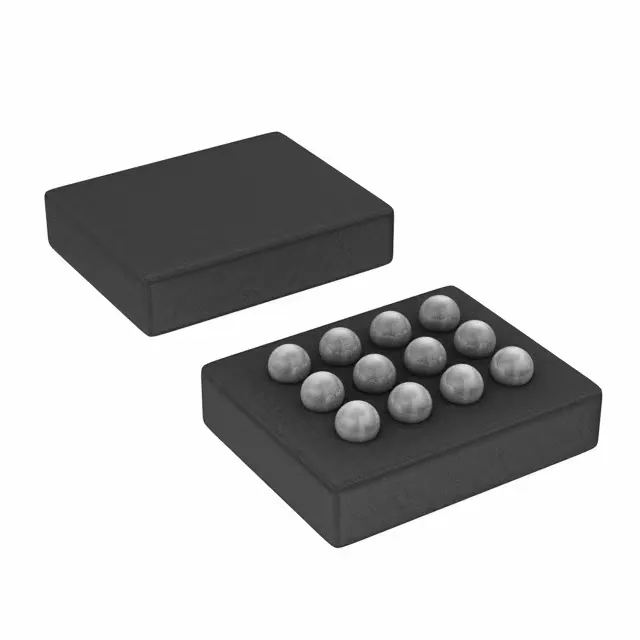
This part comes in a 12-bump DSBGA (Die-Size Ball Grid Array) package, also listed as 12-UFBGA. A four-layer board with microvia-in-pad is the standard assembly approach; two-layer boards will struggle with fan-out. The supply range spans 2.5 V to 6 V, so it runs from a single Li-ion cell (3.0 V to 4.2 V) or a 5 V USB rail without a separate pre-regulator.
For a production BOM, this means standard lead times through distribution — no allocation scramble or LTB window to manage. The base product number is TPS61050, so any future die revision or package variant will share the same base.